Quick answer · 짧은 답
Those first three steps in the morning. Why each heel takes four times your body weight, why two feet wear out differently, and what helps.
아침에 딛는 첫 세 걸음. 두 발이 정반대로 망가지는 이유와 실제로 되돌리는 방법. 검도를 해온 카이로프랙터가 설명합니다.
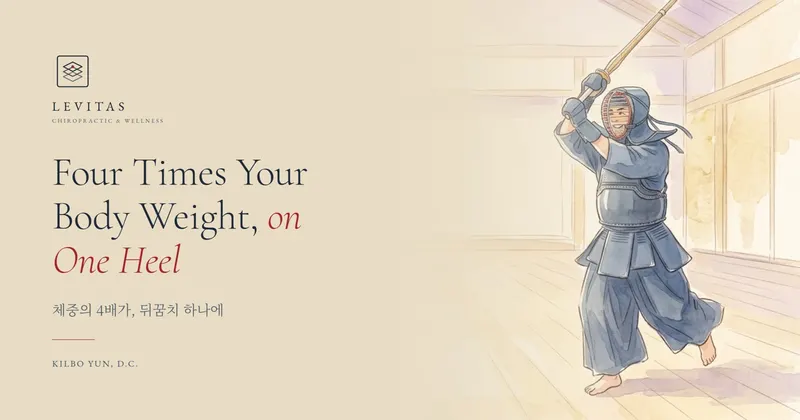
Four Times Your Body Weight, on One Heel
체중의 4배가, 뒤꿈치 하나에
Core & Spine · 숨과 척추 — No.10
Those first three steps in the morning
아침에 딛는 첫 세 걸음
Tomorrow morning, when you swing your legs out of bed and put your feet on the floor, pay attention to the first three steps.
For a lot of people reading this, those three steps are the worst three steps of the whole day. Sharp, right under the heel. And then, oddly, it fades. By the time you've had coffee you've almost forgotten about it.
That fading is the problem. It doesn't mean it got better. It means you stopped noticing.
내일 아침 침대에서 다리를 내리고 바닥에 발을 딛는 순간, 첫 세 걸음을 한번 유심히 느껴보세요.
이 글을 읽고 계신 많은 분들에게 그 세 걸음이 하루 중 제일 아픈 세 걸음입니다. 뒤꿈치 바로 아래가 날카롭게요. 그런데 이상하게 곧 사라집니다. 커피 한 잔 마실 때쯤이면 거의 잊어버리죠.
사라지는 게 문제입니다. 나아진 게 아니에요. 신경을 안 쓰게 된 겁니다.
4× — your body weight, one heel, one instant
체중의 4배 · 뒤꿈치 하나 · 찰나
When you drive forward and land that fumikomi stamp, the ground pushes back with about four times your body weight. It doesn't spread out across your foot the way you'd hope. It arrives all at once, in a fraction of a second, through the narrow pad of one heel. Your right one.
I didn't learn that number from a textbook. I learned it from my own feet, years before I knew there was a number for it.
앞으로 밀고 나가면서 후미코미로 바닥을 밟는 순간, 바닥은 체중의 4배 정도로 되받아칩니다. 우리가 바라는 것처럼 발 전체로 퍼지지도 않아요. 찰나에, 한꺼번에, 뒤꿈치 하나의 좁은 면적으로 몰려서 들어옵니다. 오른쪽 뒤꿈치죠.
저는 이 숫자를 교과서에서 배운 게 아닙니다. 이런 숫자가 있다는 걸 알기 훨씬 전에, 제 발로 먼저 배웠어요.
Before I was a chiropractor
카이로프랙터가 되기 전에
I started kendo in middle school and kept at it through my twenties. Somewhere in there I competed at a national amateur championship as a representative of Seoul, and won.
I run a clinic in Edmonds now. Kendo is still the sport I love most. I still know what the floor sounds like near the end of a long keiko, and I still know how the right heel feels the next morning when you swing your legs out of bed.
Before chiropractic, I spent twelve years as a trainer, running a rehabilitation studio in Korea, putting athletes back together after their sport had taken something from them. So when a kendoka sits down in my office, we don't have to start from the beginning. I know what chudan does to a body over ten years, because I felt most of it happen to mine. Then I spent a whole career learning how to undo it.
저는 중학교 때 검도를 시작해서 20대 중반까지 계속했습니다. 그 사이에 전국 아마추어 대회에 서울 대표로 나가서 우승한 적도 있고요.
지금은 에드먼즈에서 클리닉을 하고 있습니다. 검도는 여전히 제가 제일 사랑하는 운동이고요. 긴 연습이 끝나갈 무렵 마룻바닥에서 나는 그 소리를 아직 압니다. 다음 날 아침 침대에서 다리를 내릴 때 오른쪽 뒤꿈치가 어떤 느낌인지도요.
카이로프랙틱을 하기 전에는 12년 동안 트레이너로 일했습니다. 한국에서 재활 스튜디오를 운영하면서, 운동이 가져가 버린 것들을 다시 채워 넣는 일을 했어요. 그래서 검도 하시는 분이 진료실에 앉으시면 처음부터 설명하지 않아도 됩니다. 중단세가 10년 동안 몸에 무슨 일을 하는지 저도 제 몸으로 겪었거든요. 그 다음엔 그걸 되돌리는 법을 배우는 데 커리어를 다 썼고요.
Your two feet are doing opposite jobs
두 발은 서로 정반대의 일을 하고 있습니다
I think this is the piece almost nobody has explained to you, and honestly it's the whole story.
In chudan, your left heel stays lifted and never comes down. That back leg is your engine. It's what launches you. Your right foot is your brake, and it catches everything the engine just made.
Two feet, one body, completely different jobs, thousands of times a week, for years on end. Of course they break down differently. And that's usually why the pain keeps coming back after you've rested it. You treated both feet like they were doing the same work, and they never were.
이건 아마 아무도 설명해 드린 적이 없는 부분일 텐데, 사실 이게 거의 전부입니다.
중단세에서 왼쪽 뒤꿈치는 들려 있고 끝까지 내려오지 않죠. 뒤에 있는 그 다리가 엔진입니다. 몸을 쏘아 보내는 쪽이에요. 오른발은 브레이크고요. 엔진이 방금 만들어낸 걸 전부 받아냅니다.
발은 두 개, 몸은 하나인데 하는 일은 완전히 다릅니다. 그러니 망가지는 모양도 다를 수밖에 없어요. 쉬었다가 복귀하면 통증이 다시 돌아오는 이유도 대개 여기 있습니다. 두 발이 같은 일을 한다고 생각하고 똑같이 관리하신 거죠. 원래 같은 적이 없었는데요.
[도식 삽입 자리 — 중단세 좌우 도식]
The brake foot, your right heel
브레이크 쪽 발, 오른쪽 뒤꿈치
Under your heel bone there's a thick pad of fat. Think of it as the shock absorber your body came with. It was built for walking around, not for taking four times your body weight a few hundred times in one evening.
When that goes on long enough, two things happen together. The fat pad gets thinner and stops cushioning the way it used to. And the plantar fascia, that thick band running along the bottom of your foot, starts to fray right where it anchors into the heel.
You probably know the sign already. Those first few steps out of bed in the morning are the worst steps of your whole day.
뒤꿈치뼈 아래에는 두툼한 지방패드가 있습니다. 몸에 원래 달려 나온 완충 장치라고 생각하시면 돼요. 걸어 다니라고 만들어진 거지, 하룻저녁에 체중 4배를 수백 번 받으라고 만들어진 게 아닙니다.
이게 오래 쌓이면 두 가지가 같이 일어납니다. 지방패드가 얇아지면서 예전만큼 충격을 못 받아주고요. 발바닥을 따라 지나가는 두꺼운 띠인 족저근막이, 뒤꿈치에 붙는 바로 그 자리에서부터 닳기 시작합니다.
신호는 아마 이미 아실 거예요. 아침에 침대에서 내려와 딛는 첫 몇 걸음이 하루 중 제일 아프죠.
The engine foot, your left Achilles
엔진 쪽 발, 왼쪽 아킬레스건
Your left ankle does something pretty violent on every single strike. It holds about twenty degrees of dorsiflexion, then snaps into plantarflexion about as fast as anything in sport. The Achilles absorbs all of that.
There's a section of that tendon, a few centimetres above the heel bone, where blood supply is at its worst. Damage there heals slowly and very quietly. It piles up without ever really announcing itself, until one day it announces itself all at once.
In one survey of high school kendo athletes, more than half had either been living with Achilles pain or had torn the tendon outright.
But the part I find most useful is this. The ones who were hurting weren't simply training harder than everyone else. Their heels were tipping inward and their arches had already dropped. A flattened arch twists that tendon a little every single time you load it. So the tendon usually isn't where the problem started. The foot underneath it is.
왼쪽 발목은 타격할 때마다 꽤 격한 일을 합니다. 20도 정도 배측굴곡으로 버티다가, 스포츠 동작 중에서도 가장 빠른 축에 드는 속도로 족저굴곡으로 튕겨 나가요. 그 힘을 아킬레스건이 전부 받습니다.
이 힘줄에는 뒤꿈치뼈에서 몇 센티미터 위쪽에 혈액 공급이 가장 나쁜 구간이 있습니다. 여기가 다치면 아주 느리게, 그리고 아주 조용히 낫습니다. 티를 안 내고 쌓이다가, 어느 날 한꺼번에 티를 내죠.
고등학생 검도 선수들을 조사한 연구에서는 절반 이상이 아킬레스건 통증을 안고 있었거나 이미 파열을 겪었습니다.
그런데 제가 제일 눈여겨보는 건 이 부분이에요. 아팠던 선수들이 남들보다 그냥 더 열심히 한 게 아니었습니다. 뒤꿈치가 안쪽으로 기울어 있었고 아치가 이미 내려앉아 있었어요. 아치가 무너진 발은 체중이 실릴 때마다 그 힘줄을 조금씩 비틉니다. 그러니까 문제가 시작된 자리는 대개 힘줄이 아니에요. 그 아래 발입니다.
And this isn't only kendo
그리고 이건 검도만의 얘기가 아닙니다
Runners. Dancers. Anyone who pushes off one side and lands on the other. Anyone who has spent years doing the same asymmetrical thing on a hard floor.
The sport changes the vocabulary. It doesn't change the mechanics. One side becomes the engine, the other becomes the brake, and the body quietly reorganises around that difference.
So if you've read this far and you've never held a shinai in your life, none of this stops applying to you.
달리기, 춤, 한쪽으로 차고 나가 다른 쪽으로 착지하는 모든 것. 딱딱한 바닥에서 같은 비대칭 동작을 몇 년씩 해온 모든 분들이요.
종목이 바뀌면 쓰는 용어가 바뀔 뿐입니다. 역학이 바뀌지는 않아요. 한쪽은 엔진이 되고 다른 쪽은 브레이크가 되고, 몸은 그 차이에 맞춰 조용히 재구성됩니다.
그러니 여기까지 읽으셨는데 죽도를 한 번도 잡아본 적이 없으시더라도, 지금까지의 이야기가 남의 얘기가 되지는 않습니다.
Why come to a chiropractor for a foot problem
발 문제인데 왜 카이로프랙터한테 오시라는 걸까요
This is exactly what I'd want to ask, so let me try to answer it properly.
저라도 물어봤을 질문이라, 제대로 답을 드려보겠습니다.
Chiropractors don't only work on spines
카이로프랙터는 척추만 다루지 않습니다
Most people picture the neck and the low back, and I understand why. But the same joint work applies to the ankle, the big toe, the wrist, the elbow, the shoulder. We call those extremity adjustments, and for a kendoka that's very often where the real problem is sitting.
There's the subtalar joint under your ankle, which decides whether your heel tips inward when you land. The joint at the base of your big toe, which has to extend properly or your arch simply can't lock. The radial head at your elbow, which absorbs the braking force of tenouchi. The little carpal joints in your wrist, which get compressed by every kote and every squeeze of the grip.
When those joints stop moving well, the muscles around them can't fire the way they were meant to. And strengthening a muscle that crosses a stuck joint mostly just builds a better compensation.
보통은 목이랑 허리를 떠올리시죠. 그럴 만합니다. 그런데 똑같은 관절 작업이 발목, 엄지발가락, 손목, 팔꿈치, 어깨에도 적용돼요. 이걸 사지관절 교정이라고 부르는데, 검도 하시는 분들은 진짜 문제가 여기에 있는 경우가 상당히 많습니다.
발목 아래 거골하관절은 착지할 때 뒤꿈치가 안쪽으로 무너질지를 결정합니다. 엄지발가락 뿌리 관절은 여기가 제대로 펴져야 아치가 잠기고요. 팔꿈치의 요골두는 테노우치의 제동력을 받아내는 자리입니다. 손목의 작은 뼈들은 코테를 맞을 때마다, 손잡이를 쥐어짤 때마다 눌리고요.
이 관절들이 잘 안 움직이면 주변 근육이 원래 방식대로 작동을 못 합니다. 굳은 관절을 지나가는 근육을 아무리 강화해도, 대개는 더 정교한 보상 패턴이 만들어질 뿐이에요.
The muscle isn't where the instruction comes from
근육은 명령이 내려오는 자리가 아닙니다
Every muscle in your arms and legs is driven by a nerve, and those nerves come out between the bones of your spine. That's just anatomy, nothing more mysterious than that.
The calf muscles feeding your Achilles get their supply from the lowest lumbar and upper sacral levels. So do the small muscles inside your foot, the ones holding your arch up. Your triceps, which brakes your strike, is supplied around the seventh cervical level. The muscles in your hand that make tenouchi possible come from the eighth cervical and first thoracic.
So if one arch keeps dropping no matter how much you train it, "this muscle is weak" is only half the question. The other half is whether the signal is arriving cleanly, and whether the joints along the way are free to move.
That's why I don't only look at the sore spot. I want to know where the instruction came from, and every joint the load travelled through to get there.
팔다리의 모든 근육은 신경이 움직입니다. 그 신경들은 척추뼈 사이로 빠져나오고요. 그냥 해부학이에요. 그 이상 신비로운 얘기는 아닙니다.
아킬레스건으로 이어지는 종아리 근육은 요추 맨 아래와 천추 위쪽에서 신경을 받습니다. 아치를 붙들고 있는 발 속 작은 근육들도 마찬가지고요. 타격을 제동하는 삼두근은 경추 7번 부근에서, 테노우치를 가능하게 하는 손의 근육들은 경추 8번과 흉추 1번에서 옵니다.
그러니 한쪽 아치가 아무리 훈련해도 계속 내려앉는다면, 이 근육이 약하다는 건 질문의 절반일 뿐이에요. 나머지 절반은 신호가 제대로 도착하고 있는지, 그 경로에 있는 관절들이 자유로운지입니다.
제가 아픈 자리만 안 보는 이유가 그겁니다. 명령이 어디서 출발했는지, 그리고 부하가 거기까지 오면서 어떤 관절들을 통과했는지를 보고 싶거든요.
In kendo the connection is visible
검도에서는 그 연결이 눈에 보입니다
Ground reaction force comes in at the left foot, travels up through the ankle, knee, hip and pelvis, passes through the spine and the tanden, and leaves at the kissaki. Everything between the floor and the tip of your shinai is one connected system.
Kendo makes that unusually easy to see, and unusually unforgiving when one link along the way is stuck. That whole chain is what I work on.
지면 반발력이 왼발로 들어와서 발목, 무릎, 고관절, 골반을 타고 올라갑니다. 척추와 단전을 지나 검끝으로 빠져나가고요. 바닥에서 죽도 끝까지가 하나로 연결된 시스템입니다.
검도는 이게 유난히 잘 보이는 운동이에요. 그리고 그 경로 중 한 군데가 굳었을 때 유난히 가차 없기도 하고요. 저는 그 연결 전체를 다룹니다.
The third bill arrives at your right elbow
세 번째 청구서는 오른쪽 팔꿈치로 옵니다
Tenouchi is a braking action. Your right elbow takes that deceleration, hard extension and a valgus stress at the same time, on every single strike. Do that for ten years and the tip of your ulna starts hammering into the groove at the back of your humerus.
In one imaging study of adult male practitioners, close to nine in ten had posterior elbow pain and a measurable loss of extension.
Here's the part that usually gets cut from that story though. Their extensor muscles had grown much stronger than their flexors, well out of proportion. That imbalance can be trained back, and the pattern that created it can be changed. So if you're reading this with a right elbow that catches a little, please don't hear it as bad news.
테노우치는 제동 동작입니다. 오른쪽 팔꿈치가 그 감속을 받아요. 강한 신전력과 외반 스트레스를 동시에, 타격 한 번마다요. 이걸 10년 하면 척골 끝이 상완골 뒤쪽 홈을 계속 두드리게 됩니다.
성인 남성 수련자들을 영상으로 조사한 연구에서는 열 명 중 아홉에 가까운 인원이 팔꿈치 뒤쪽 통증과 신전 가동범위 감소를 보였습니다.
그런데 이 이야기에서 보통 잘려 나가는 부분이 있어요. 신전근이 굴곡근보다 훨씬 강해져 있었습니다. 이 불균형은 훈련으로 되돌릴 수 있고, 그걸 만든 패턴도 바꿀 수 있어요. 그러니 오른쪽 팔꿈치가 좀 걸리는 상태로 읽고 계시더라도, 나쁜 소식으로 받아들이지 않으셨으면 합니다.
And then there's the force you receive
그리고 받는 쪽도 있습니다
Everything so far has been about the force you make. But kendo puts force into you as well, and that half hardly ever gets talked about.
Taiatari. Body contact loads your ribs, mid back and low back all at once, usually while your spine is already rotated. When those joints stiffen, your breath stops going all the way down and your trunk stops rotating evenly. A trunk that won't rotate makes your shoulder and elbow work harder to finish the strike.
Men. Even through good bogu, a men strike doesn't stop at the men. Your neck is a small structure being asked to decelerate your head many times in a session. Protective padding degrades as it ages, and older headgear absorbs noticeably less energy than new. If your men is old, it isn't only worn out. It's passing more of every strike through to your neck.
지금까지는 전부 내가 만들어내는 힘 이야기였습니다. 그런데 검도는 힘을 받기도 하죠. 이쪽 절반은 거의 얘기가 안 됩니다.
몸받음. 몸이 부딪히는 순간 갈비뼈와 등과 허리가 한꺼번에 부하를 받습니다. 그것도 대개 척추가 이미 돌아가 있는 상태에서요. 여기가 굳으면 숨이 끝까지 안 내려가고, 몸통 회전이 좌우로 고르지 않아집니다. 몸통이 안 돌면 타격을 마무리하려고 어깨와 팔꿈치가 더 일하게 되죠.
머리 타격. 좋은 호구를 써도 멘 타격은 호면에서 멈추지 않습니다. 목은 작은 구조물인데 한 연습에서 머리를 수십 번 감속시키는 일을 맡고 있어요. 보호 패딩은 시간이 지나면 성능이 떨어지고, 오래된 호면은 새 호면보다 눈에 띄게 적은 에너지를 흡수합니다. 호면이 낡았다는 건 단순히 헐었다는 뜻이 아니에요. 매 타격의 더 많은 몫을 목으로 흘려보내고 있다는 뜻입니다.
The floor is quietly multiplying all of this
바닥이 이 모든 걸 조용히 키우고 있습니다
A purpose built dojo floor is sprung. There's give underneath it, and it eats part of the impact before your foot ever feels it. Most community gym floors are thin wood laid over concrete. That floor gives back everything you put into it, and a bit more.
So if you train on a hard rented floor and you've felt that it's different, you're not imagining it. Your body is right about that.
검도 전용으로 지은 도장 바닥은 탄성 마루입니다. 아래에 완충이 있어서, 발이 느끼기도 전에 충격의 일부를 먹어 줘요. 그런데 커뮤니티 체육관 바닥은 대부분 콘크리트 위에 얇은 나무를 덧댄 구조죠. 넣은 힘을 그대로 돌려주고, 조금 더 얹어서 돌려줍니다.
그러니 딱딱한 대여 바닥에서 수련하시면서 여기는 좀 다르다고 느끼셨다면, 착각이 아닙니다. 몸이 맞게 느끼고 있는 거예요.
Three quick questions
세 가지만 여쭤볼게요
Are the first few steps out of bed the worst steps of your day? Is your left calf always tight the day after keiko, tight enough that you've stopped even noticing it? Does something catch at the back when you straighten your right arm all the way?
If any of those sounds like you, please take it as good news rather than bad. None of them means the damage is permanent. What they mean is that load is already going somewhere it shouldn't, and it's going to keep going there until something further upstream changes. Which is a very fixable situation, and much easier to fix now than in three years.
아침에 침대에서 내려와 딛는 첫 몇 걸음이 하루 중 제일 아프신가요? 연습 다음 날 왼쪽 종아리가 늘 뻐근한데, 이젠 뻐근한 줄도 모를 만큼 익숙해지셨나요? 오른팔을 끝까지 펴면 뒤쪽에서 뭔가 걸리시나요?
셋 중 하나라도 해당되신다면, 나쁜 소식이 아니라 좋은 소식으로 받아들이셨으면 합니다. 어느 것도 이미 망가졌다는 뜻이 아니에요. 부하가 가면 안 되는 자리로 이미 가고 있다는 뜻이고, 위쪽에서 뭔가 바뀌기 전까지는 계속 그리로 간다는 뜻입니다. 충분히 손볼 수 있는 상황이고, 3년 뒤보다 지금이 훨씬 쉽습니다.
Two things you can start tonight
오늘 밤부터 하실 수 있는 두 가지
Roll out your calf and the sole of your foot. After keiko, give it a few minutes. Foam roller along the calf, a ball or small roller under the arch. Go slowly, keep breathing, and stay off the tendon itself. This won't rebuild anything, and I don't want to oversell it. What it does is keep the tissue from tightening overnight, and that overnight tightening is exactly why those first morning steps hurt the way they do.
Get a real pad under your right heel. A proper shock absorbing pad genuinely lowers the force reaching the bone. A thin cotton one does very little. Gel or a purpose made insert does a lot more.
Both of these belong to you. You don't need me for either one, and I'd much rather you start tonight than wait for an appointment.
종아리와 발바닥 풀어주기. 연습 끝나고 몇 분만 시간을 내주세요. 폼롤러로 종아리를 밀어주시고, 공이나 작은 롤러로 발바닥 아치 쪽을 굴려주시면 됩니다. 천천히, 숨 쉬면서요. 아킬레스건 자체는 피하시고요. 이게 뭘 다시 만들어주지는 않습니다. 과장해서 말씀드리고 싶지 않아요. 다만 밤사이 조직이 굳는 걸 막아줍니다. 아침 첫 걸음이 그렇게 아픈 이유가 바로 그 굳음이거든요.
오른쪽 뒤꿈치에 제대로 된 패드를 넣으세요. 제대로 된 충격 흡수 패드는 뼈까지 닿는 힘을 정말로 줄여줍니다. 얇은 면 패드는 거의 소용이 없고, 젤이나 전용 인서트가 훨씬 낫습니다.
이 두 가지는 여러분 겁니다. 저 없이도 하실 수 있어요. 예약을 기다리시는 것보다 오늘 밤에 시작하시는 게 훨씬 낫습니다.
And the part worth coming in to learn
그리고 오셔서 배우실 만한 것
Rolling loosens tissue. It doesn't build an arch. If your arch has already dropped, no amount of rolling brings it back. That takes specific strengthening, and which exercise, at what load, depends entirely on what your foot is actually doing when your weight is on it.
None of that can be worked out from a screen. It has to be watched while you're loaded and moving.
An exercise done wrong isn't a smaller version of the right one. It's practice at being wrong.
You already know this better than most people, because you've watched a beginner swing a shinai ten thousand times and get worse at it, simply because nobody stood beside them and fixed the grip. Your feet are no different. The same short foot exercise, done with the toes gripping instead of the arch lifting, builds the exact pattern you were trying to undo.
So that's what a visit is really for. Not to be treated and sent home, but to be shown, corrected, and to walk out knowing your own numbers and knowing what to do with them.
Come and learn it properly. Then go home and do it yourself. That order works well. The other one hardly ever does.
롤러는 조직을 풀어줍니다. 아치를 세워주지는 않아요. 아치가 이미 내려앉았다면 아무리 굴려도 안 돌아옵니다. 그건 특정한 근력 훈련이 필요한 일이고, 어떤 운동을 어느 강도로 할지는 체중이 실렸을 때 그 발이 실제로 어떻게 움직이는지에 전적으로 달려 있어요.
이건 화면으로 알아낼 수 있는 게 아닙니다. 체중이 실린 채 움직이는 걸 봐야 해요.
잘못된 운동은 올바른 운동의 축소판이 아닙니다. 잘못된 것을 연습하는 거예요.
이건 다른 누구보다 잘 아실 겁니다. 초보가 죽도를 만 번 휘두르고도 오히려 나빠지는 걸 보셨을 테니까요. 옆에 서서 손 잡는 법을 고쳐주는 사람이 없었을 뿐이죠. 발도 다르지 않습니다. 같은 쇼트 풋 운동이라도 아치를 들어올리는 대신 발가락으로 움켜쥐면서 하면, 되돌리려던 바로 그 패턴을 더 단단하게 만듭니다.
그래서 오시는 겁니다. 치료받고 집에 가시라는 게 아니라, 보시고, 교정받으시고, 본인 숫자와 그걸로 무엇을 해야 하는지를 알고 나가시는 거예요.
오셔서 제대로 배우세요. 그 다음엔 집에서 혼자 하시면 됩니다. 이 순서는 잘 됩니다. 반대 순서는 거의 안 되고요.
One last thing
마지막으로 하나만
There's an anime I've loved since I was young. Eureka Seven, episode two. The main character is fourteen and he's running. The military is behind him, he's never won anything in his life, and he reaches the edge with nowhere left to go.
He jumps.
The cliff is enormous. He's a speck against it, arms out, no bottom in sight. And on the way down, some words come back to him. His father's words, left behind years earlier on the day he walked out and never came home. The boy has never once been able to fly.
ねだるな、勝ち取れ。さすれば与えられん。
Don't wait for it. Win it. Then it will be given to you.
Then he flies.
Those words had been sitting inside him for years. Inherited, unused, not really believed. Right up until the one moment he had nothing left to do but say them in his own voice.
제가 어릴 때부터 좋아한 애니메이션이 있습니다. 에우레카 세븐 2화예요. 주인공은 열네 살이고 도망치는 중입니다. 뒤에는 군대가 있고, 살면서 뭘 이겨본 적도 없고, 더 갈 데 없는 끝에 도달합니다. 그리고 뛰어내립니다.
떨어지는 와중에 어떤 말이 떠오릅니다. 아버지가 남긴 말이에요. 몇 년 전 집을 나가 다시 돌아오지 않던 날 남긴 말이요. 그때까지 아이는 단 한 번도 날아본 적이 없었습니다.
기다리지 마라. 쟁취해라. 그러면 주어질 것이다.
그리고 날아오릅니다.
그 말은 몇 년째 그 안에 그냥 놓여 있었습니다. 물려받았지만 쓰이지 않았고, 사실 믿지도 않았죠. 남은 게 그것뿐인 그 한순간에 자기 목소리로 말하기 전까지는요.
We're living to a hundred now. It isn't a headline anymore, it's a plan we're all already in, whether we signed up for it or not. And the question was never really how long. It's what condition we arrive in.
Carrying your own bags. Getting up off the floor without having to think about it first. Breathing all the way down. Sleeping through the night without your body reminding you it's there. Being the one who helps, for as long as possible, rather than the one being helped.
Nobody hands you the second half in good condition. You build it now.
Not later, once it starts to hurt. Now, in the years when it still feels unnecessary, out of small unglamorous things done fairly consistently. I wish there were a better method. There isn't one.
So please don't wait for your body to sort itself out, and please don't push through and hope. Go win it back, and it will be given back. You don't have to go alone.
이제 100세 시대죠. 더 이상 뉴스 헤드라인이 아니라, 신청한 적도 없는데 우리 모두가 이미 들어와 있는 계획입니다. 그리고 질문은 사실 한 번도 얼마나 오래 사느냐였던 적이 없어요. 어떤 몸으로 도착하느냐입니다.
내 짐을 내 손으로 드는 것. 바닥에서 일어날 때 먼저 생각하지 않아도 되는 것. 숨이 끝까지 내려가는 것. 몸이 자기 존재를 알려오지 않는 밤을 통째로 자는 것. 그리고 가능한 한 오래, 도움을 받는 쪽이 아니라 도와주는 쪽으로 남는 것.
후반전을 좋은 몸으로 쥐여주는 사람은 없습니다. 지금 만들어 두는 겁니다.
아프기 시작한 다음이 아니라, 아직 안 해도 될 것 같은 지금요. 별로 멋있지도 않은 작은 것들을 그럭저럭 꾸준히 해서요. 더 나은 방법이 있으면 좋겠는데, 없더라고요.
그러니 몸이 알아서 정리되기를 기다리지 마세요. 버티면서 잘 견뎌주기를 바라지도 마시고요. 가서 쟁취해 오세요. 그러면 주어집니다. 혼자 가실 필요 없습니다.
Thank you for reading all the way to the end. I know you could be doing a hundred other things. It genuinely means something.
끝까지 읽어주셔서 감사합니다. 다른 하실 일도 많으셨을 텐데요. 저한테는 정말 큰 의미입니다.
Book a visit · 예약하기
Kilbo Yun, D.C.
Doctor of Chiropractic
Levitas Chiropractic & Wellness
23700 Edmonds Way, Edmonds, WA 98026
levitaschiropractic.com
This article is for education only and is not a diagnosis or treatment plan. If you have sudden calf pain, an audible pop, or cannot bear weight, please seek medical care immediately. If a head strike leaves you dizzy, nauseated, or with an unfamiliar headache, stop practice and seek medical evaluation the same day.
본 글은 교육 목적이며 진단이나 치료 계획이 아닙니다. 갑작스러운 종아리 통증, 퍽 하는 소리, 체중을 실을 수 없는 상태라면 즉시 진료를 받으십시오. 머리를 맞은 뒤 어지럽거나 메스껍거나 평소와 다른 두통이 있다면, 그날 수련을 멈추고 당일에 진료를 받으십시오.
#검도부상 #발건강 #Kendo #Fumikomi #SportsChiropractic
View the full brochure · 브로셔 전체 보기