Quick answer · 짧은 답
Muscle is where sugar goes and energy gets made, and a stiff joint quietly raises the cost of every move. Why strength and movement belong together.
근육은 당이 들어가는 방이자 에너지를 만드는 공장입니다. 그리고 굳은 관절은 모든 움직임의 비용을 조용히 올립니다. 에드먼즈 카이로프랙틱 원장이 설명합니다.
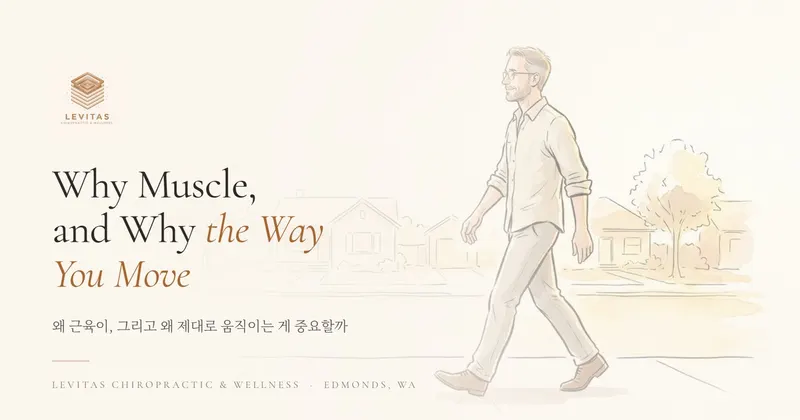
Why Muscle, and Why the Way You Move
왜 근육이, 그리고 왜 제대로 움직이는 게 중요할까
You were never the one who needed to worry. Same size for twenty years. Same clothes still fitting. Nobody ever told you to be careful — because whatever it is people get warned about, you didn’t look like it.
나는 걱정할 쪽이 아니었습니다. 이십 년째 같은 체형이고, 옷도 그대로 맞습니다. 조심하라는 말을 들어본 적도 없어요. 사람들이 조심하라고 하는 그 모습이, 내 모습은 아니었으니까요.
Then a number came back from a blood test that didn’t match the mirror, and it took a while to believe. Not because it was frightening. Because it seemed to belong to someone else’s body.
그런데 어느 날 피검사에서 거울과 안 맞는 숫자가 하나 나옵니다. 믿는 데 시간이 걸리죠. 무서워서가 아니라, 그게 내 몸 이야기 같지가 않아서요.
So let’s start underneath all of it. Why does muscle matter so much, and why does the way you move matter just as much?
그래서 맨 아래에서부터 시작해보려고 합니다. 왜 근육이 그렇게 중요하고, 어떻게 움직이느냐가 왜 그만큼 중요할까요.
Your body doesn’t store energy the way you think
우리 몸은 에너지를 저장하지 않습니다
Everything your body does runs on a molecule called ATP. Think of it as cash, not savings. What you have on hand lasts seconds — not minutes. Everything past that has to be manufactured on demand, continuously, for your entire life.
몸이 하는 모든 일은 ATP라는 물질로 돌아갑니다. 통장 잔고가 아니라 지갑 속 현금이라고 보시면 돼요. 손에 쥐고 있는 양은 몇 초치입니다. 몇 분이 아니라 몇 초요. 그 이후는 전부 그때그때 만들어 써야 하고, 그 일이 평생 단 한 순간도 쉬지 않고 계속됩니다.
Your body isn’t a battery. It’s a power plant that has never once shut down.
몸은 배터리가 아닙니다. 한 번도 멈춘 적 없는 발전소예요.
Even doing nothing costs you
가만히 있어도 계속 나갑니다
Your nerve cells hold an electrical charge across their outer wall, like a bow held drawn, ready to fire a signal the instant it’s needed. Holding that readiness isn’t free. Tiny pumps in the cell wall run around the clock, burning ATP for no other purpose than keeping the bow drawn.
신경 세포는 세포막을 사이에 두고 늘 전기를 머금고 있습니다. 활시위를 당겨놓은 채로 언제든 신호를 쏠 준비를 하고 있는 거예요. 그런데 그 상태를 유지하는 게 공짜가 아닙니다. 세포막에 붙은 작은 펌프들이 24시간 쉬지 않고 돌면서, 오직 그 시위를 당겨두기 위해 ATP를 태웁니다.
A remarkably large share of everything your brain spends goes to exactly that — staying ready. Before you lift anything, before you stand up, your body is already paying rent.
뇌가 쓰는 에너지의 상당 부분이 오직 그것, 대기 상태를 유지하는 데만 들어갑니다. 뭘 들기도 전에, 일어서기도 전에, 몸은 이미 월세를 내고 있는 셈이죠.
The plant that makes it lives inside your muscle
그걸 만드는 공장은 근육 안에 있습니다
Those power plants are called mitochondria, and the overwhelming majority of them sit inside skeletal muscle.
그 발전소를 미토콘드리아라고 부릅니다. 그리고 그 대부분이 골격근 안에 살고 있어요.
This is the connection almost nobody makes. When you eat, glucose has to leave the bloodstream and go somewhere. The largest destination is muscle — and the reason muscle takes it is that muscle is where it gets burned. Sugar doesn’t vanish. It’s carried into these plants and turned into ATP.
여기가 거의 아무도 연결하지 않는 지점입니다. 식사를 하면 포도당은 혈관 밖으로 나가 어딘가로 들어가야 합니다. 가장 큰 목적지가 근육이고, 근육이 그걸 받아들이는 이유는 거기가 태우는 자리이기 때문입니다. 당은 그냥 사라지지 않아요. 이 공장 안으로 실려 들어가서 ATP가 되는 겁니다.
Muscle also has a second door. When a muscle contracts, it pulls glucose in through a route that doesn’t wait for insulin to unlock it. The contraction itself opens the door. That’s part of why ten minutes of walking after dinner does something sitting after dinner doesn’t.
근육에는 문이 하나 더 있습니다. 근육이 수축할 때는 인슐린이 문을 열어주기를 기다리지 않고도 포도당을 끌어당기는 통로가 열립니다. 수축 자체가 문을 여는 겁니다. 식후 10분 걷기가 식후에 앉아 쉬는 것과 다른 이유의 일부가 여기 있어요.
So muscle was never about strength, and certainly never about how you look. It’s the size of the room sugar has to move into, and the number of furnaces waiting inside it.
그러니까 근육은 애초에 힘 이야기가 아니었고, 몸매 이야기는 더더욱 아니었습니다. 당이 들어갈 방의 크기이자, 그 안에서 기다리는 화로의 개수입니다.
And you can build more of them
그리고 공장은 늘릴 수 있습니다
Mitochondria are not a fixed inheritance. When a muscle works long enough that its ATP starts running short, the cell notices. A sensor inside it detects the shortage and flips a master switch that tells the cell to build more power plants. Do that consistently over weeks and months, and the muscle physically remodels itself into a larger factory.
미토콘드리아는 타고나는 정해진 몫이 아닙니다. 근육이 충분히 오래 일해서 세포 안의 ATP가 부족해지기 시작하면, 세포가 그걸 알아챕니다. 안에 있는 감지 장치가 에너지 고갈을 감지하고, 공장을 더 지으라는 마스터 스위치를 켭니다. 몇 주, 몇 달 꾸준히 하면 근육은 실제로 자기 구조를 다시 짜서 더 큰 공장 단지가 됩니다.
That sentence is worth reading twice. The machinery that handles your blood sugar is machinery you can build.
이 문장은 한 번 더 읽으실 만합니다. 내 혈당을 처리하는 그 설비를, 내가 지을 수 있다는 뜻입니다.
But it only gets built one way. The cell has to actually run short of energy. There is no shortcut around the working part.
다만 지어지는 방법은 하나뿐입니다. 세포가 실제로 에너지가 모자라야 해요. 일하는 부분을 건너뛰는 지름길은 없습니다.
Thin was never the same as safe
마르다는 건 안전하다는 뜻이 아니었습니다
Weight is a rough measure. It can’t tell muscle from anything else. Two people at the same number on the scale can carry entirely different amounts of muscle, and entirely different amounts of fat sitting quietly around the organs where nobody can see it.
체중은 아주 거친 지표입니다. 근육인지 아닌지를 구분하지 못해요. 체중계에 같은 숫자가 뜨는 두 사람이 근육량이 완전히 다를 수 있고, 눈에 안 보이는 장기 주변 지방의 양도 완전히 다를 수 있습니다.
If you’ve always been lean and never really trained, your factory has been small your whole life. Nobody noticed, because none of it shows on a scale. And muscle is expensive to maintain — the body gives it up quickly when it isn’t used. Every quiet year takes a few plants offline.
평생 마른 체형이었고 운동은 제대로 안 해왔다면, 내 공장은 평생 작은 상태였던 겁니다. 아무도 몰랐죠. 체중계에는 안 나오니까요. 게다가 근육은 유지 비용이 비싼 조직이라 안 쓰면 몸이 금방 내놓습니다. 조용히 지나간 한 해 한 해가 공장 몇 개씩을 꺼온 거예요.
Thin never protected you. It just delayed the conversation.
마른 게 나를 지켜준 게 아니었습니다. 대화를 늦춰준 것뿐입니다.
But this is where the road forks. Your body isn’t damaged and in need of reversing. It simply hasn’t been built yet. What the cell needs in order to hear that instruction isn’t your training history — it’s the next few months.
그런데 여기서 방향이 갈립니다. 몸이 망가져서 되돌려야 하는 상황이 아니에요. 아직 지어지지 않았을 뿐입니다. 세포가 그 명령을 알아듣는 데 필요한 건 지금까지의 운동 경력이 아니라 앞으로의 몇 달이고요.
So I don’t read this as bad news. Finding out late and being too late are different things.
그래서 저는 이걸 나쁜 소식으로 보지 않습니다. 늦게 안 것과 늦은 것은 다릅니다.
Having no weight to lose is not the advantage people assume
뺄 살이 없다는 건 유리한 조건이 아닙니다
Someone carrying extra weight has an obvious lever to pull. You don’t have that lever. The work in front of you is to build — and building is slower, harder and less forgiving than losing. It takes load, consistency, and months, because that’s the only language the cell responds to.
체중이 많이 나가는 분에게는 당길 수 있는 확실한 지렛대가 있습니다. 우리에겐 그게 없어요. 앞에 놓인 일은 덜어내는 게 아니라 만드는 일입니다. 그리고 만드는 건 빼는 것보다 느리고, 어렵고, 봐주는 게 없습니다. 부하가 필요하고, 꾸준함이 필요하고, 몇 달이 필요합니다. 세포가 알아듣는 언어가 그것뿐이라서요.
Nobody says this out loud. They tell you to eat well and stay active, and you nod, because you already look like someone who does both.
이걸 대놓고 말해주는 사람이 없습니다. 잘 드시고 활동적으로 지내시라는 말을 듣고 고개를 끄덕이죠. 이미 그렇게 사는 사람처럼 보이니까요.
So you start. And your body stops you.
그래서 시작합니다. 그런데 몸이 먼저 멈춥니다.
Three weeks in, your shoulder catches when you reach overhead. Your wrist goes numb halfway through. Your low back aches for two days after a session that shouldn’t have cost anything.
3주쯤 되면 팔을 머리 위로 올릴 때 어깨가 걸립니다. 하다가 손목이 저리고요. 별것 아닌 운동을 했는데 허리가 이틀을 갑니다.
A lean, untrained body has no buffer. Muscle doesn’t only move joints — it protects them, absorbing load before the joint has to. With less of it, the joint takes the impact directly, from the very first session.
마르고 훈련이 안 된 몸에는 완충이 없습니다. 근육은 관절을 움직이기만 하는 게 아니라 보호합니다. 관절이 부담을 받기 전에 먼저 충격을 흡수해줘요. 그게 적으면 관절이 그 부하를 그대로 받습니다. 그것도 첫날부터요.
And your connective tissue may already have changed. Collagen builds your tendons, ligaments and joint capsules — picture loose rope fibres that have to slide past one another for a joint to move freely. When blood sugar runs high over long stretches, sugar molecules attach to those fibres and bond them together. The ropes stop sliding. They behave like one stiff cable.
그리고 결합조직이 이미 변해 있을 수 있습니다. 콜라겐은 힘줄과 인대, 관절낭을 만드는 재료입니다. 여러 밧줄 가닥이 서로 미끄러지며 지나가야 관절이 부드럽게 움직여요. 혈당이 오래 높게 유지되면 당 분자가 그 섬유에 달라붙어 가닥끼리 묶어버립니다. 밧줄이 미끄러지질 않아요. 한 덩어리 굵은 케이블처럼 굳는 겁니다.
Sugar syrup on a cool counter: liquid, then sticky, then hard. That’s why the shoulder that won’t lift, the finger that catches, the wrist that goes numb at night show up so often in people whose numbers have been quietly high for years. It isn’t bad luck and it isn’t in your head. The tissue itself is different.
설탕물을 식은 조리대에 흘려두면 액체였다가, 끈적해지고, 나중엔 딱딱해지죠. 안 올라가는 어깨, 걸리는 손가락, 밤에 저리는 손목이 수치가 조용히 높은 채로 몇 년을 보낸 분들에게 유독 흔한 이유가 이겁니다. 운이 나쁜 것도, 예민한 것도 아니에요. 조직 자체가 달라진 겁니다.
A stiff joint also wrecks your fuel economy
굳은 관절은 연비까지 망칩니다
A joint that can’t travel its full range doesn’t cancel the work. It hands the work to its neighbours. Muscles that should be quietly steadying you start doing the lifting instead. More tissue gets recruited for the same movement — and more tissue burns more ATP. Same squat, same reach, higher bill.
제 범위만큼 못 움직이는 관절이 있으면, 그 일이 사라지는 게 아니라 옆으로 넘어갑니다. 조용히 몸을 잡아주기만 하면 되는 근육이 대신 무게를 들게 돼요. 같은 동작에 동원되는 조직이 늘어나고, 조직이 늘어난 만큼 ATP도 더 태웁니다. 같은 스쿼트, 같은 손 뻗기인데 청구서만 커지는 거죠.
Joints also report. Every time one travels through its range it tells the brain where the body is. A joint that barely moves sends a vague signal, and the brain has to plan with worse information. Poor information makes the body cautious: more bracing, more muscles held on at once, more fuel burned for the same walk.
관절은 보고도 합니다. 제 범위를 오갈 때마다 지금 몸이 어디 있는지를 뇌에 알려주거든요. 잘 안 움직이는 관절은 그 신호를 희미하게 보냅니다. 뇌는 나쁜 정보로 계획을 짜게 되고, 그러면 몸은 보수적으로 갑니다. 더 힘주고, 더 많은 근육을 동시에 잡아두고, 같은 산책에 연료를 더 태웁니다.
It’s driving with the parking brake half on. You still arrive. The engine just paid more for the trip. So the exercise feels harder than it should, it hurts in places you weren’t training, and it wears you out disproportionately. All three have the same mechanical root.
사이드 브레이크를 반쯤 걸고 운전하는 것과 같습니다. 도착은 합니다. 다만 엔진이 그 길에 더 많이 썼고요. 운동이 유난히 힘든 것, 훈련하지도 않은 데가 아픈 것, 한 일에 비해 과하게 지치는 것. 셋 다 뿌리가 같습니다.
The loop that costs the most
가장 손해가 큰 고리
Start. Joint gives out. Stop for a month. Lose the little you’d built. Start again from further back. Do that three or four times and something worse than an injury happens — you decide that exercise isn’t for you. And the factory keeps shrinking, quietly, for years.
시작한다 → 관절이 나간다 → 한 달 쉰다 → 겨우 붙은 근육이 다시 빠진다 → 더 뒤에서 다시 시작한다. 이걸 서너 번 하면 부상보다 나쁜 일이 생깁니다. “운동은 나랑 안 맞나 보다”라고 결론 내려버리는 거예요. 그때부터 공장은 몇 년에 걸쳐 조용히 계속 줄어듭니다.
The injuries aren’t the real damage. The stopping is.
진짜 손해는 다친 게 아닙니다. 멈춘 겁니다.
Which is exactly where this office comes in
바로 여기가 이 진료실의 자리입니다
Chiropractic care does not treat metabolic disease. It does not change what’s in your bloodwork, and nothing here replaces the plan your physician has you on.
카이로프랙틱은 대사 질환을 치료하지 않습니다. 피검사 수치를 바꾸지 않고, 여기 있는 어떤 것도 주치의가 세운 계획을 대신하지 못합니다.
What this care does is take one link in that loop — the joint that has lost its motion and made movement hurt — and work on it directly. Find the joint that isn’t traveling its full range. Restore the motion, so the load stops being handed sideways and the signal to your brain sharpens again. Calm the tissue around it. Then rebuild a movement pattern that doesn’t quietly overload the same shoulder every single session.
이 진료가 하는 일은 그 고리에서 딱 한 마디를 잡는 것입니다. 움직임을 잃어서 통증을 만들고 있는 관절이요. 제 범위를 못 가는 관절을 찾아냅니다. 그 움직임을 돌려줘서 부하가 옆으로 떠넘겨지는 걸 멈추고, 뇌로 가는 신호가 다시 또렷해지게 합니다. 주변 조직을 가라앉힙니다. 그다음에 매번 같은 어깨에 조용히 과부하를 거는 그 패턴을 다시 짭니다.
The goal is narrow, and I’d rather state it plainly than oversell it. To make it possible for you to keep training. Training is what builds the plants. My job is to remove the reason you keep having to stop.
목표는 좁습니다. 부풀리지 않고 그대로 말씀드릴게요. 운동을 계속하실 수 있게 만드는 것. 공장을 짓는 건 운동이고, 제 일은 자꾸 멈추게 만드는 이유를 치우는 겁니다.
What happens on a first visit
첫 방문에 일어나는 일
I don’t ask where it hurts and then look only there. The painful spot is usually the victim, not the culprit. If you come in for a shoulder, I start by checking whether your mid-back and ribs are moving enough to let that arm finish the reach.
어디가 아프냐고 묻고 그 자리만 보지 않습니다. 아픈 자리는 대개 범인이 아니라 피해자거든요. 어깨 때문에 오셨어도, 저는 등뼈와 갈비뼈가 그 팔을 끝까지 올려줄 만큼 움직이고 있는지부터 봅니다.
And I have you move. Stand up out of the chair. Pick something up. Raise your arms. Lying still while someone presses on you won’t tell either of us why the shoulder caught in week three. That only shows up in motion.
그리고 직접 움직여보시게 합니다. 의자에서 일어나보시고, 뭔가를 들어보시고, 팔을 올려보십니다. 누워서 만져보는 것만으로는 3주 뒤에 왜 어깨가 걸렸는지 알 수 없어요. 그건 움직이는 걸 봐야 보입니다.
Before I was a chiropractor, I spent over twelve years coaching movement in rehabilitation and training settings — learning how to progress load, and where to stop, in the room rather than from a book. So I don’t treat what I find on the table and what shows up under a barbell as two separate problems. They’re usually the same problem.
저는 카이로프랙터이기 이전에, 12년 넘게 재활과 트레이닝 현장에서 사람들의 움직임을 직접 지도해 왔습니다. 부하를 어떻게 올리고 어디서 멈춰야 하는지를 책이 아니라 현장에서 배웠습니다. 그래서 저는 진료대에서 찾은 문제와 바벨 앞에서 드러나는 문제를 따로 보지 않습니다. 대개 같은 문제거든요.
People who can’t exercise because it hurts usually get one of two answers. On one side, rest. On the other, push through. Rest and the muscle leaves. Push through and it costs you more next month.
아파서 운동을 못 하시는 분들은 보통 두 가지 대답만 들으십니다. 한쪽에서는 “쉬세요”, 다른 쪽에서는 “참고 하세요”. 쉬면 근육이 빠지고, 참으면 다음 달에 더 크게 나갑니다.
What we settle here is the space between those. Which joint to open first. What you’ll do this week now that it’s open, and how many. Where the line is that means stop. You leave with what you can do right now — not a list of what you can’t.
여기서 정하는 건 그 사이입니다. 어느 관절을 먼저 열지, 그게 열린 상태에서 이번 주에 무엇을 몇 개나 하실지, 어디까지 가면 멈추셔야 하는지. 못 하는 것 말고, 지금 하실 수 있는 것을 정해서 나가시게 됩니다.
Which is why most people walk out holding one or two things to do at home today. Not a printout. Something you did once in front of me, and that I corrected while you did it.
그래서 대부분 오늘 집에서 하실 동작 한두 개를 들고 나가십니다. 프린트물이 아니라, 제 앞에서 한 번 해보시고 제가 고쳐드린 동작으로요.
Three things to try this week
이번 주에 해보실 세 가지
1. Both arms straight overhead. If one stops early or catches, the problem is often not the shoulder but the mid-back below it. An arm only finishes the reach if the back follows.
1. 양팔을 곧게 머리 위로. 한쪽이 먼저 멈추거나 걸린다면, 문제는 어깨가 아니라 그 아래 등뼈일 가능성이 높습니다. 팔은 등이 따라 움직여줘야 끝까지 올라가거든요.
2. Stand from a chair without your hands. If you quietly push through one leg, your body is already avoiding a side. Start squatting from there and that preference grows along with the weight.
2. 손 안 쓰고 의자에서 일어나기. 한쪽 다리로 슬쩍 밀고 일어나신다면, 몸은 이미 한쪽을 피하고 있는 겁니다. 그 상태로 스쿼트를 시작하면 그 편애가 무게와 함께 커집니다.
3. Grip something firmly for thirty seconds. Tingling, numbness, or a difference between sides — that one goes to your physician first. Tell me as well, because it changes what’s appropriate here.
3. 뭔가를 30초 꽉 쥐기. 저리거나, 감각이 무디거나, 좌우가 다르다면 — 이건 주치의 선생님께 먼저 말씀하셔야 하는 신호입니다. 저에게도 꼭 알려주셔야 하고요. 여기서 무엇이 적절한지가 달라집니다.
If any of those catch, that’s what we’ll look at first. Remember it, and lead with it.
하나라도 걸리는 게 있으면, 그게 첫 방문에 저와 함께 볼 자리입니다. 기억해두셨다가 그것부터 말씀해 주세요.
One last thing
마지막으로
You were never lazy. You were told for years that this wasn’t your problem, and your body agreed with them.
게을러서 이렇게 된 게 아닙니다. 이건 네 문제가 아니라는 말을 몇 년 동안 들으셨고, 몸도 그렇게 보였으니까요.
What’s needed now isn’t regret. It’s an order of operations. Find what’s blocked, open it, and build on top of it. Every plant you add is one that wasn’t there yesterday, and they’ll keep adding at any age you start.
지금 필요한 건 반성이 아니라 순서입니다. 어디가 막혀 있는지 찾고, 거기를 열고, 그 위에 지을 것을 짓는 것. 하나 늘린 공장은 어제까지 없던 공장이고, 그건 몇 살에 시작하든 늘어납니다.
And you don’t have to work out that order alone. We can decide it together.
그리고 그 순서를 혼자 정하지 않으셔도 됩니다. 같이 정하면 됩니다.
If English has been the wall in a doctor’s office, you can do all of this in Korean here. All of it.
진료실에서 영어가 벽이 되셨다면, 여기서는 한국어로 하셔도 됩니다. 전부 다요.
Kilbo Yun, D.C. Doctor of Chiropractic Levitas Chiropractic & Wellness 23700 Edmonds Way, Edmonds, WA 98026
Book a visit · 예약하기
Further Reading · 참고 문헌
Hodgkin AL, Huxley AF. A quantitative description of membrane current and its application to conduction and excitation in nerve. The Journal of Physiology, 1952.
Skou JC. The influence of some cations on an adenosine triphosphatase from peripheral nerves. Biochimica et Biophysica Acta, 1957.
Astrup J, et al. Oxygen consumption in rat brain cortex slices related to sodium pump activity. The Journal of Physiology, 1981.
Hardie DG. AMPK: positive and negative regulation, and its role in whole-body energy homeostasis. Current Opinion in Cell Biology, 2015.
Puigserver P, Spiegelman BM. PGC-1 alpha: transcriptional coactivator and metabolic regulator. Endocrine Reviews, 2003.
Bodine SC, et al. Akt/mTOR pathway is a crucial regulator of skeletal muscle hypertrophy. Nature Cell Biology, 2001.
Gastin PB. Energy system interaction and relative contribution during maximal exercise. Sports Medicine, 2001.
Brooks GA. The lactate shuttle during exercise and recovery. Medicine and Science in Sports and Exercise, 1986.
View the full brochure · 브로셔 전체 보기