Quick answer · 짧은 답
아픈 자리와 시작된 자리는 다를 때가 많습니다. 걸음, 온기, 촉진, 움직임, 영상. 다섯 가지가 같은 자리를 가리킬 때 한 마디만 교정합니다. 에드먼즈 레비타스 카이로프랙틱.
아픈 자리와 시작된 자리는 다를 때가 많습니다. 걸음, 온기, 촉진, 움직임, 영상. 다섯 가지가 같은 자리를 가리킬 때 한 마디만 교정합니다. 에드먼즈 레비타스 카이로프랙틱.
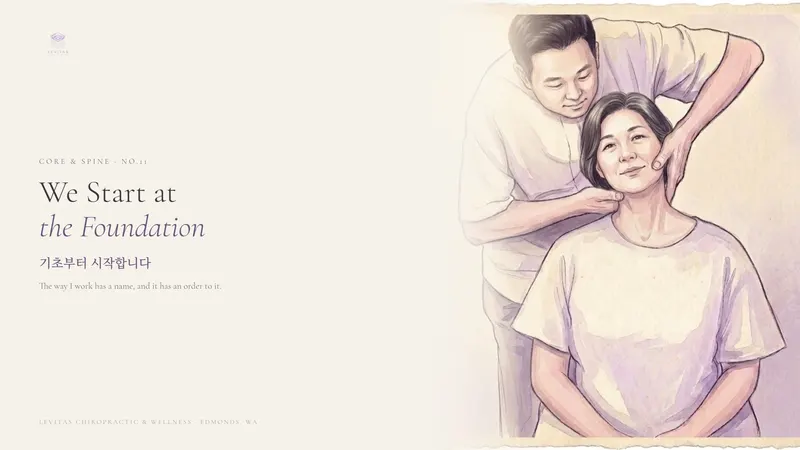
We Start at the Foundation
기초부터 시작합니다
Core & Spine · No.11 · Levitas Chiropractic & Wellness, Edmonds WA
Most people come in and point at a spot. The shoulder. The side of the neck. One corner of the low back. That spot is real, and it’s usually where the trouble first spoke up. It’s just rarely where the trouble began.
대부분은 오셔서 한 곳을 짚으십니다. 어깨, 목 옆, 허리 한쪽. 그 자리가 아픈 건 맞아요. 문제가 처음으로 티를 낸 자리이기도 하고요. 다만 시작된 자리인 경우는 드뭅니다.
The way I work has a name. It’s called Gonstead, and more useful than the name is this: it has an order. Here’s what that order looks like from your side of the table.
제가 일하는 방식에는 이름이 있습니다. 간스테드라고 불러요. 이름보다 중요한 건 순서가 있다는 점이고요. 환자분 자리에서 보면 그 순서가 어떻게 흘러가는지 적어 볼게요.
A building leans from the bottom
건물은 아래에서부터 기웁니다
Think of your spine as a tall building. The pelvis and the sacrum are the base it stands on.
척추를 높은 건물이라고 생각해 보세요. 골반과 천골이 그 건물이 딛고 선 바닥입니다.
Tilt that base by a few millimetres and every floor above has to lean a little just to stay upright. Nothing dramatic happens that day. But the leaning never stops, and the floors doing most of the work eventually say something about it. Years later a crack shows up near the top.
바닥이 몇 밀리미터만 기울어도 위층은 전부 조금씩 기대야 서 있을 수 있어요. 그날 무슨 큰일이 나지는 않습니다. 다만 기대는 일이 계속되고, 제일 많이 버틴 층이 언젠가는 티를 냅니다. 몇 해가 지나서 위층에 금이 가는 거예요.
That crack is what you feel, and of course it is. It’s the loud part. But if you patch the wall on the fifteenth floor while the base is still off, you’ll be back with a brush next year.
느껴지는 건 그 금이죠. 당연합니다. 제일 시끄러운 부분이니까요. 그런데 바닥이 기운 채로 15층 벽만 메우면, 내년에 또 붓을 들게 됩니다.
The man who worked this out was an engineer
이걸 정리한 사람은 엔지니어였어요
He trained in mechanical engineering first. At nineteen he was bedridden with severe arthritis, walked out of it after chiropractic care, and went to chiropractic school in the aftermath.
원래 기계공학을 공부한 사람이었습니다. 열아홉에 심한 관절염으로 자리에 누웠다가 카이로프랙틱 치료를 받고 다시 걷게 됐고, 그러고 나서 학교로 갔어요.
That order matters. He didn’t look at a spine and see a set of bones to loosen. He saw a structure standing under load, and he asked the question an engineer asks. Where is this thing actually carrying weight, and what happens upstairs when the bottom isn’t level?
순서가 중요합니다. 그는 척추를 보고 ‘풀어야 할 뼈들’이라고 생각하지 않았어요. 하중을 받고 서 있는 구조물로 봤고, 엔지니어가 던질 법한 질문을 했습니다. 이 물건은 실제로 어디서 무게를 받고 있나, 그리고 바닥이 수평이 아니면 위층에서는 무슨 일이 벌어지나.
It’s the cushion, not the bone
뼈가 아니라, 사이에 있는 쿠션이에요
Here’s the part that changed how this is done, and it’s worth a minute.
여기가 이 방식을 바꿔 놓은 대목입니다. 잠깐 들여다볼 값어치가 있어요.
Between every two bones in your spine there’s a soft cushion, and right in the middle of it sits a gel core. The bones turn on that core the way something turns on a ball bearing, and the weight spreads out evenly across the whole surface.
척추뼈 사이마다 부드러운 쿠션이 하나씩 있고, 그 한가운데에 젤 같은 중심이 들어 있습니다. 뼈는 볼베어링 위에서 돌듯 그 중심 위에서 움직이고, 무게는 면 전체에 고르게 퍼져요.
When a bone slides off centre, the gel gets pushed to one side and the cushion stops sitting level. Now one edge is carrying more than its share. The fibres in that crowded wall get strained, the tissue there swells, and it’s the swelling that leans on the nerve. Not the bone itself.
그런데 뼈가 가운데에서 조금 벗어나면 그 젤이 한쪽으로 밀립니다. 쿠션이 더 이상 평평하지 않게 되죠. 한쪽 가장자리가 제 몫보다 많이 받게 되고, 그 벽의 섬유가 당겨지고, 그 자리가 붓습니다. 신경을 누르는 건 그 부기예요. 뼈가 아니고요.
So the goal isn’t to move a bone in general. It’s to set that one bone back down flat on its cushion, so the weight spreads again and the swelling finally has a reason to settle.
그래서 목표는 뼈를 그냥 움직이는 게 아닙니다. 그 뼈 하나를 쿠션 위에 다시 평평하게 내려놓는 것이에요. 그래야 무게가 다시 퍼지고, 부기도 가라앉을 이유가 생깁니다.
Five readings, then a decision
다섯 번 확인하고, 그다음에 정합니다
No single finding decides anything on its own. I take five separate readings and look at whether they’re all pointing at the same place. If four agree and one doesn’t, I go back and look again.
하나만 보고 정하지 않습니다. 서로 다른 다섯 가지를 따로 확인하고, 전부 같은 자리를 가리키는지 봐요. 넷이 맞는데 하나가 어긋나면, 다시 봅니다.
One. I watch you walk in. Before I touch anything, I stand behind you and look. One shoulder carried a little higher. A shoulder blade sitting further out. A hip that swings wider than the other. None of that is the problem itself. It’s more like a map of how you’ve been getting around it.
하나. 걸어 들어오시는 걸 봅니다. 손을 대기 전에 뒤에 서서 봅니다. 한쪽 어깨가 조금 올라가 있는지, 견갑골이 더 튀어나와 있는지, 골반이 한쪽으로 더 흔들리는지. 그게 문제 자체는 아니에요. 그동안 어떻게 버텨오셨는지가 보이는 지도에 가깝습니다.
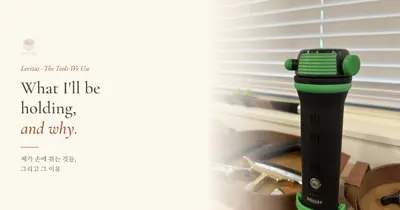
Two. I read the warmth. You check a fever with the back of your hand before you reach for anything else. You’re reading heat. This does the same thing, just more patiently. Two small sensors comparing your right side against your left, one level at a time, all the way down. About a minute or two. No pressure to speak of, no current, no radiation.
둘. 온기를 읽습니다. 열이 나는지 볼 때 손등을 먼저 이마에 대보시잖아요. 온기를 읽는 거예요. 이 기계도 같은 일을 조금 더 꼼꼼히 합니다. 작은 센서 두 개가 좌우를 한 마디씩 짝지어 위에서 아래까지 비교해요. 1~2분 정도 걸리고, 누르지도 않고 방사선도 없습니다.
A healthy back is even from side to side. Same level, same warmth. So I’m not measuring a number. I’m comparing a pair, all the way down. The level where the pair stops matching is the one worth looking at.
건강한 등은 좌우가 고릅니다. 같은 높이면 온기도 비슷해요. 그래서 저는 숫자 하나를 재는 게 아니라, 위에서 아래까지 짝을 지어 비교합니다. 그 짝이 어긋나는 마디가 들여다볼 자리예요.
The needle is never perfectly still, by the way. Muscles are warm, rooms have drafts, and that gentle wandering is completely normal. I let it go. What I’m watching for is a turn that arrives and leaves within a finger’s width.
참고로 바늘은 늘 조금씩 움직입니다. 근육도 따뜻하고 실내 공기도 흐르니까요. 그 완만한 흔들림은 그냥 넘어갑니다. 제가 보는 건 손가락 한 마디 폭 안에서 확 꺾였다가 곧장 돌아오는 자리예요.
Three. My hands look at the spine still. I feel for softness that shouldn’t be there, and for skin that has gone slightly pitted. If that texture is there, it usually means it’s been going on a while.
셋. 가만히 있을 때의 척추를 손으로 봅니다. 있으면 안 되는 물렁함이 있는지, 피부 결이 살짝 오돌토돌해졌는지 만져 봅니다. 그 결이 잡히면 대개 꽤 오래됐다는 뜻이에요.
Four. Then the spine moving. I ask each joint to move and feel for the one that stops early, like a drawer catching on something behind it.
넷. 움직일 때의 척추를 봅니다. 마디마다 움직여 보면서, 서랍이 뒤에 뭔가 걸리듯 일찍 멈추는 마디를 찾습니다.
Five. Last, the drawing of the building. Nobody renovates a building without seeing the plans first. The film tells me what my hands can’t. How far the base sits off level, which way a segment has turned, what the space between two bones actually looks like. It also tells me where I shouldn’t push, and that matters just as much.
다섯. 마지막으로 건물의 설계도를 봅니다. 설계도를 안 보고 건물에 손대지는 않으니까요. 영상은 손으로 알 수 없는 걸 알려줍니다. 바닥이 얼마나 기울었는지, 어느 마디가 어느 쪽으로 돌아갔는지, 뼈 사이 공간이 어떤 상태인지. 그리고 어디는 밀면 안 되는지도요. 그게 그만큼 중요합니다.
One segment, not the whole row
한 마디입니다, 줄줄이가 아니라
A dentist who finds one cavity doesn’t drill the rest of your mouth just to be safe.
치과에서 충치 하나를 찾았다고 나머지 치아까지 손대지는 않으시죠.
All that reading is for one purpose. It earns the right to touch a single segment, in one direction, and leave everything else alone. If a level reads clean, I leave it. You don’t need my hands there.
앞의 모든 확인은 딱 하나를 위한 겁니다. 한 마디를, 한 방향으로 손댈 자격을 얻는 것. 나머지는 그대로 둡니다. 깨끗하게 나오는 마디는 그냥 둬요. 굳이 손댈 이유가 없으니까요.
And especially not the loose ones. When one segment locks up, the ones next to it start moving extra to cover for it. Those are usually the parts that feel tight and make you want a good crack. Working on them buys about twenty minutes, and the locked segment stays exactly where it was.
특히 헐거워진 마디는 건드리지 않습니다. 한 마디가 잠기면 옆에 있는 마디들이 대신 더 많이 움직이면서 메워요. 그리고 시원하게 소리 한번 내고 싶어지는 곳이 보통 그 마디들입니다. 거기를 풀면 한 이십 분 편해요. 잠긴 마디는 그대로 있고요.
People often ask about the sound. The sound isn’t the goal. It’s a by-product, and it can happen whether or not anything useful took place. What I’m after is the segment sitting back where it belongs.
소리에 대해서도 자주 물어보십니다. 소리가 목적은 아니에요. 부산물에 가깝고, 의미 있는 일이 일어났든 아니든 날 수 있습니다. 제가 원하는 건 그 마디가 제자리에 놓이는 거예요.
Straight in, never a twist
비틀지 않고, 곧게 들어갑니다
The wall of that cushion is built a bit like plywood. Fibres in layers, and each layer runs at an angle across the one underneath it. That crosswise weave is what makes it strong when you press straight down on it.
그 쿠션의 벽은 합판이랑 비슷하게 만들어져 있어요. 섬유가 층층이 쌓여 있고, 각 층이 아래층을 가로지르는 각도로 놓여 있습니다. 그 엇갈린 짜임 덕분에 위에서 곧게 누르는 힘에는 강해요.
Wring it, though, and only half the fibres in each layer end up taking the strain. That’s the direction it’s weakest in.
대신 비틀면 각 층에서 절반의 섬유만 그 힘을 받습니다. 제일 약한 방향이 그쪽이에요.
So the correction goes in as a short, straight line along the plane of the cushion. No wringing, no rotation. It’s also why getting you into position takes longer than the adjustment itself. Setting up the line is most of the work. The push is the short part.
그래서 교정은 쿠션의 면을 따라 짧고 곧은 직선으로 들어갑니다. 비틀지 않아요. 자세 잡는 데 시간이 더 걸리는 이유도 그거고요. 선을 맞추는 게 일의 대부분이고, 실제로 미는 순간은 짧습니다.
The table is chosen for the person
테이블도 사람에 맞춰서 고릅니다
A tailor doesn’t hand everyone the same jacket. There isn’t one table here either.
양복점에서 모두에게 같은 재킷을 내주지는 않죠. 여기 테이블도 하나가 아닙니다.
Kneeling forward lets gravity open the mid-back before I touch it. Sitting upright means your neck gets corrected while it’s actually holding your head up, which is the job it has to do the rest of the day, and it happens without turning it. A side-lying bench suits the pelvis. Which one you end up on is part of the decision, not just furniture.
무릎 꿇고 엎드리면 손대기 전에 중력이 등을 먼저 열어 줘요. 앉은 자세는 목이 실제로 머리를 받치고 있는 상태 그대로, 그리고 돌리지 않고 교정하기 위해서고요. 하루 종일 목이 하고 있는 일이 그거니까요. 옆으로 눕는 벤치는 골반에 맞습니다. 어느 테이블에 눕느냐도 판단의 일부예요.
Where this is headed
이 길이 향하는 곳
As things settle, what I find gets fainter. I show you that every time instead of asking you to take my word for it. Once before, once after.
자리가 잡히면 찾아지는 것도 점점 옅어집니다. 그걸 매번 같이 확인해요. 제 말만 믿으시라고 하고 싶지 않아서요. 교정 전에 한 번, 후에 한 번.
If I can’t explain what led me to one segment, then I haven’t earned it yet. Ask me right there in the room. That’s honestly the part I most want to show you.
한 마디를 고른 이유를 설명드리지 못하면, 아직 손댈 준비가 안 된 거예요. 진료실에서 편하게 물어봐 주세요. 사실 제가 제일 보여드리고 싶은 부분이 그겁니다.
Getting back to the things you actually want to be doing. That’s where we’re headed, together.
하고 싶으신 일 하면서 지내시는 것. 거기까지 같이 가려고요.
Book a visit · 예약하기
Kilbo Yun, D.C. Doctor of Chiropractic Levitas Chiropractic & Wellness 23700 Edmonds Way, Edmonds, WA 98026 levitaschiropractic.com
Core & Spine · 숨과 척추 · No.11
View the full brochure · 브로셔 전체 보기