Quick answer · 짧은 답
The deep part of your back that carries load without complaint. The signs it's tired and how we help it start working again.
The part of your back that never asks for help
등에는, 좀처럼 자기 얘기를 하지 않는 자리가 있습니다
Core & Spine · No.08 — 숨과 척추, 여덟 번째 이야기
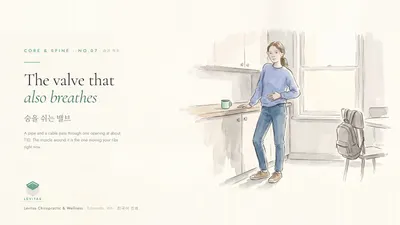
She had been rubbing the same spot on her low back for eight months. Standing at the kitchen counter waiting for the kettle, one hand always going to the same place without her thinking about it. She had stretched it. She had rested it. It would ease for a few days and then quietly come back.
여덟 달째 같은 자리를 문지르고 계셨습니다. 주방에서 물 끓기를 기다리며, 생각도 없이 손이 늘 그 자리로 갔다고요. 스트레칭도 해보고 쉬어도 봤습니다. 며칠 편해졌다가, 또 조용히 돌아오고요.
Here is the thing about that spot. It was where she could feel it. It was not where it was coming from.
그 자리는 느껴지는 곳이었지, 시작되는 곳은 아니었습니다.
i. A door in the wrong place
Two things pass through. The third goes around the back.
둘은 뚫고 지나가고, 하나는 뒤로 돌아갑니다
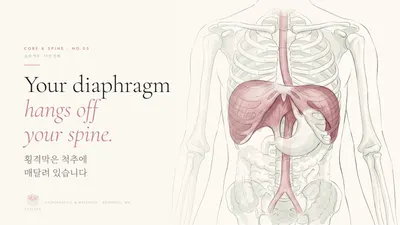
Your diaphragm is the sheet of muscle under your ribs that does your breathing. Things have to get past it, and two of them go straight through — like cables through a wall.
횡격막은 갈비뼈 아래에서 숨을 쉬게 해주는 근육 막입니다. 이 막을 지나가야 하는 것들이 있는데, 그중 둘은 벽에 뚫린 구멍으로 전선이 지나가듯 그냥 통과합니다.
The third one does something different. It never crosses the muscle at all — it slips behind it, tucked against the front of your spine. And that changes what this level is for.
그런데 세 번째는 다릅니다. 근육을 아예 건드리지 않아요. 척추 바로 앞을 따라 뒤로 돌아서 지나갑니다. 그래서 이 자리는 성격 자체가 다릅니다.
T12 isn't a doorway. It's where the diaphragm holds on.
T12는 뭔가 지나다니는 문이 아니라, 횡격막이 척추를 붙잡는 자리입니다.
ii. The anchor
Your diaphragm has legs.
횡격막에는 다리가 있습니다
Most people picture the diaphragm as a floating dome. It isn't floating at all. Two long muscular legs reach down from it and take hold of the bones in your lower back, gripping them the whole way down.
횡격막을 그냥 떠 있는 돔처럼 생각하시는 분이 많습니다. 그런데 전혀 떠 있지 않아요. 길쭉한 두 다리가 아래로 내려와서 허리뼈를 붙잡습니다. 아래까지 쭉 붙들고 있는 겁니다.
Think of pitching a tent. The canvas isn't what holds the shape — the stakes are. Drive them in properly and the whole thing goes taut and quiet. Leave one loose and the canvas flaps all night, no matter how good the fabric is.
텐트를 떠올려 보세요. 모양을 잡아주는 건 천이 아니라 땅에 박은 말뚝이죠. 말뚝만 제대로 박히면 천이 팽팽해지면서 조용해집니다. 하나라도 헐거우면, 천이 아무리 좋아도 밤새 펄럭입니다.
Every breath you take pulls on those stakes. About twenty thousand times a day.
숨을 쉴 때마다 그 말뚝이 당겨집니다. 하루에 이만 번쯤요.
iii. And it lands on a hinge
Same spine. Different rules.
같은 척추인데, 위아래가 서로 다르게 움직입니다
Right where those legs take hold, your spine changes its mind about what it will allow. Above that line the joints are built to turn. Below it, they're built to refuse.
그 다리들이 붙잡는 바로 그 자리에서, 척추는 태도를 바꿉니다. 그 경계 위쪽 관절은 돌아가도록 만들어져 있고, 아래쪽 관절은 안 돌아가도록 만들어져 있습니다.
So this one line is doing two jobs at once. It's the anchor point for every breath, and it's the seam where turning stops. Reaching into the back seat for a grocery bag asks it to do both in the same second.
그러니까 이 한 줄이 두 가지 일을 동시에 하고 있는 겁니다. 숨 쉴 때마다 당겨지는 닻이면서, 회전이 멈추는 이음매이기도 하고요. 뒷좌석에서 장바구니 하나 집으려고 몸을 트는 순간, 이 자리가 그 둘을 한꺼번에 해냅니다.
A door never breaks in the middle of the panel. It breaks at the hinge.
문이 고장 날 때, 판이 부러지진 않죠. 늘 경첩이 먼저입니다.
iv. Why it hides
It rarely hurts where it starts.
원인은, 아픈 곳에 없습니다
When this junction stops moving well, it doesn't complain locally. It sends the feeling somewhere else entirely — down into the low back, out across the hip, sometimes into the crease of the groin. Press on the junction itself and often there's nothing there to find.
이 부위가 잘 안 움직이기 시작하면, 정작 그 자리는 아프다는 말을 안 합니다. 느낌을 다른 데로 보내요. 허리 아래로, 엉덩이 바깥쪽으로, 때로는 사타구니 접히는 곳까지요. 막상 그 자리를 눌러보면 아무렇지도 않은 경우가 많습니다.
Which is why the ache keeps coming back after it eases. The spot that hurts gets all the attention. The spot that started it never gets asked.
그래서 좀 나아졌다가도 자꾸 돌아옵니다. 아픈 자리는 계속 관심을 받는데, 시작된 자리는 한 번도 확인을 못 받거든요.
v. This is chiropractic work
Motion is the thing we are trained to read.
움직임을 읽는 것, 그게 저희가 훈련받은 일입니다
A junction like this doesn't show up as damage. Nothing is torn. Nothing is broken. What has changed is how one segment moves against the next — a little stiffness in one direction, a little too much in another. That is precisely the thing chiropractic training is built around: putting hands on a spine, segment by segment, and feeling where the motion stops.
이런 부위는 손상으로 나타나지 않습니다. 찢어진 것도, 부러진 것도 없어요. 달라진 건 한 마디가 다음 마디에 대해 어떻게 움직이느냐입니다. 한쪽으로는 조금 뻑뻑하고, 다른 쪽으로는 조금 과하게 움직이고요. 척추에 손을 얹고 한 마디씩 짚어가며 움직임이 어디서 멈추는지 느끼는 것 — 카이로프랙틱이 바로 그걸 위해 훈련하는 일입니다.
And because the diaphragm anchors right there, breathing and spinal motion aren't two separate subjects. They're one subject. Restore the movement at the seam, and the anchor has something solid to pull against again.
그리고 횡격막이 바로 그 자리에 붙어 있기 때문에, 호흡과 척추 움직임은 별개의 주제가 아닙니다. 하나의 주제예요. 이음매의 움직임이 돌아오면, 닻도 다시 단단한 데를 붙잡고 당길 수 있게 됩니다.
That is also why we look before we work. We watch how your ribs move when you breathe. We check the junction segment by segment with our hands. We watch you bend and turn and reach. Then we read all three together — because separately, each one tells you almost nothing.
그래서 저희는 손을 대기 전에 먼저 봅니다. 숨 쉴 때 갈비뼈가 어떻게 움직이는지 보고, 그 이음매를 손으로 한 마디씩 확인하고, 굽히고 돌리고 뻗는 동작을 봅니다. 그리고 이 셋을 함께 읽습니다. 따로 떼어놓으면 각각은 거의 아무것도 말해주지 않거든요.
One thing worth saying plainly. None of this means something is damaged. A joint that has stopped moving freely is not a joint that is broken — it is a joint that has been asked to do two things at once for a long time, and has quietly stopped doing one of them.
한 가지는 분명히 말씀드리고 싶습니다. 이건 어디가 망가졌다는 얘기가 아닙니다. 잘 안 움직이는 관절이 부러진 관절은 아니에요. 오랫동안 두 가지 일을 한꺼번에 해오다가, 그중 하나를 조용히 놓아버린 것뿐입니다.
A note from Kilbo Yun, D.C.
I spent years training and competing before I ever treated anyone, and the lesson that stayed with me is a simple one: the place that hurts is usually the place that gave out last, not the place that failed first. Bodies are patient. They hand the work to a neighbour long before they say anything about it.
환자를 보기 전에 저는 오랫동안 운동을 하고 시합을 뛰었습니다. 그때 남은 교훈은 단순합니다. 아픈 자리는 보통 마지막에 무너진 자리이지, 처음 무너진 자리가 아니라는 것. 몸은 참을성이 많습니다. 아프다고 말하기 훨씬 전부터, 옆자리에 조용히 일을 떠넘깁니다.
So when someone tells me their low back has been aching for months, the first place I put my hands is usually a little higher than they expect. Not because the low back doesn't matter — but because it has been carrying someone else's work for a long time, and it deserves to be let off.
그래서 몇 달째 허리가 아프다고 하시면, 제 손이 처음 가는 자리는 대개 생각보다 조금 위쪽입니다. 허리가 중요하지 않아서가 아니라, 그동안 남의 몫까지 오래 지고 왔기 때문입니다. 이제는 좀 내려놓아도 되니까요.
If your back eases for a few days and then quietly returns, let's take a look together.
며칠 편해졌다가 또 조용히 돌아온다면, 한번 같이 살펴봅시다.
Kilbo Yun · 마음을 담아, 윤길보 원장
Kilbo Yun, D.C. / Doctor of Chiropractic · 12+ Years Personal & Rehab Training
Book a visit · 예약하기
levitaschiropractic.com · 23700 Edmonds Way, Edmonds, WA 98026 · KakaoTalk 리비타스 카이로프락틱
View the full brochure · 브로셔 전체 보기