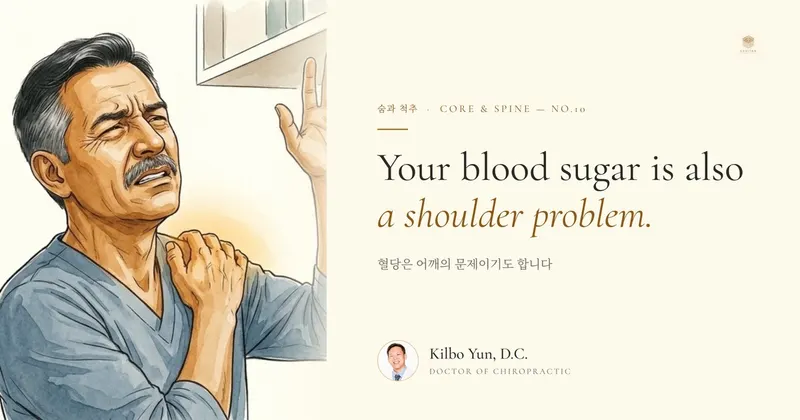
Quick answer · 짧은 답
Why shoulders stiffen more often and heal more slowly with diabetes, three checks you can do at home, and why stretching alone can't reach the problem.
당뇨가 있으면 어깨와 목이 더 자주, 더 오래 굳습니다. 왜 그런지, 집에서 확인하는 세 가지 방법, 그리고 스트레칭만으로는 왜 부족한지 — Edmonds 레비타스 카이로프랙틱.
Core & Spine · 숨과 척추 — No.10
좀처럼 안 풀리는 어깨가 있습니다
There's a kind of shoulder I've come to recognize.
The person is doing everything right. Stretching. Resting. Not overdoing it. And still — the top shelf has quietly moved out of range. Putting on a coat takes a plan. Sleeping on that side stopped being an option a while ago.
When someone describes that to me, I ask something that catches them off guard. How has your blood sugar been? Most people blink. What does that have to do with my shoulder? Quite a lot, as it turns out.
제가 이제는 딱 알아보는 어깨가 있습니다.
이런 분들은 뭘 잘못하고 계신 게 아니에요. 스트레칭도 하시고, 쉬기도 하시고, 무리도 안 하십니다. 그런데도 선반 위 물건 하나 내리는 게 하나의 사건이 됩니다. 코트 입는 데 요령이 필요해지고, 그쪽으로 누워 자는 건 언젠가부터 포기하셨고요.
그런 이야기를 들으면 저는 좀 엉뚱한 걸 여쭤봅니다. "혈당은 좀 어떠세요?" 대부분 잠깐 멈칫하세요. 그게 어깨랑 무슨 상관인가 싶으신 거죠. 상관이, 꽤 많습니다.
i. 붙어버린 밧줄
Picture a tendon as a bundle of thin ropes lying side by side. They're meant to slide against each other — that sliding is what freedom of movement actually is.
Now imagine someone dabbing a little syrup at every point where those ropes cross. One drop does nothing. Neither does a hundred. But over years, the ropes stop sliding and start moving as one thick, sticky bundle.
And here's the part that frustrates people most: the same process slows the tiny new blood vessels that healing depends on. The tissue gets stiffer and repairs slower, at the same time. If you've wondered why your shoulder is taking twice as long as your friend's — you're not imagining it, and you're not doing it wrong.
힘줄을 가느다란 밧줄 여러 가닥이 나란히 누워 있는 거라고 생각해 보세요. 이 가닥들은 서로 미끄러지게 되어 있습니다. 그 미끄러짐이 곧 '부드럽게 움직인다'는 말의 실체예요.
그런데 누가 그 밧줄들이 겹치는 자리마다 물엿을 한 방울씩 발라 놓는다고 상상해 보세요. 한 방울로는 아무 일도 안 일어납니다. 백 방울도 그래요. 그런데 몇 년이 지나면, 가닥들이 따로 미끄러지지 못하고 하나의 두껍고 끈적한 덩어리처럼 움직이기 시작합니다.
환자분들이 제일 답답해하시는 부분은 여기부터입니다. 조직을 굳게 만드는 바로 그 과정이, 회복에 꼭 필요한 미세혈관이 새로 자라는 속도까지 늦춰 놓습니다. 더 뻣뻣해지면서, 동시에 더 늦게 낫는 거죠. "왜 나는 친구보다 두 배는 오래 걸리지?" 하셨다면, 착각이 아닙니다. 그리고 뭔가를 잘못하고 계신 것도 아닙니다.
ii. 유난히 자주 오는 것들
None of these belong only to diabetes. They just come more often, and stay longer.
Frozen shoulder — the capsule tightens like a shirt that shrank in the wash. Reaching behind the back goes first. Around one in five.
Stiff, waxy hands — press your palms flat together as if praying. If a gap stubbornly stays, that's this.
Trigger finger — a finger catches, then lets go with a small snap.
Carpal tunnel — burning and numbness in the thumb-side fingers, usually worst at 3 a.m. Reported in up to a third.
A mid-back and neck that simply don't turn as far as they used to.
이 중에 당뇨에만 있는 건 하나도 없습니다. 다만 더 자주 오고, 더 오래 머뭅니다.
오십견 — 관절을 감싼 주머니가, 잘못 빨아서 줄어든 셔츠처럼 조여듭니다. 등 뒤로 손 넣기가 제일 먼저 안 됩니다. 다섯 분 중 한 분 정도로, 보통의 두 배쯤.
손이 뻣뻣하고 밀랍처럼 되는 것 — 기도하듯 두 손바닥을 딱 붙여 보세요. 아무리 해도 틈이 남는다면 이겁니다.
방아쇠 수지 — 손가락이 걸렸다가 툭 하고 펴집니다.
손목터널증후군 — 엄지 쪽 손가락이 타는 듯 저립니다. 하필 새벽 세 시에 제일 심하고요.
예전만큼 안 돌아가는 목과 등.
One more piece, and I'd rather tell you straight than round it off: in men, diabetes has been linked to a clearly higher chance of frequent back, neck and shoulder pain. In women, the same work didn't find that increase. That doesn't make a woman's stiff shoulder less real — I see plenty of them.
하나 더 말씀드릴 게 있는데, 대충 뭉개는 것보다 정확히 말씀드리는 편이 낫겠습니다. 남성의 경우 당뇨가 있으면 등·목·어깨 통증이 자주 생길 가능성이 뚜렷하게 높다는 보고가 있습니다. 여성에서는 같은 연구에서 그 증가가 확인되지 않았고요. 그렇다고 여성분의 굳은 어깨가 덜 진짜라는 뜻은 절대 아닙니다. 저희 진료실에도 많이 오십니다.
iii. 지금 앉은 자리에서 해보실 수 있는 것
These don't diagnose anything. They tell you whether the front and back of your neck have quietly stopped sharing the work.
01. Lie down and slowly lift your head to look at your feet.
If your chin shoots forward instead of tucking in, the deep muscles at the front of your neck have gone quiet and the surface ones have taken the shift.
02. Tuck your chin, lift your head a fingernail's height, and hold.
Shaking, chin poking, or the head drifting down means those deep muscles tire fast. Almost everyone is worse at this than they expect. Including me, the first time someone tested me.
03. Sit, bend one elbow to a right angle, raise the arm out to the side.
If the shoulder shrugs toward your ear before the arm reaches about sixty degrees, the top of your shoulder is starting a movement your shoulder blade was supposed to start.
진단하는 게 아닙니다. 목의 앞과 뒤가 일을 나눠 하고 있는지, 아니면 어느 한쪽이 손을 놨는지만 알려주는 거예요.
하나. 누워서 천천히 고개를 들어 발끝 보기. 턱이 당겨지지 않고 앞으로 쑥 나온다면, 목 앞쪽 깊은 근육이 조용해지고 겉 근육이 그 일을 대신 떠맡은 겁니다.
둘. 턱 당기고 손톱 두께만큼 들어 버티기. 떨리거나, 턱이 나오거나, 머리가 스르르 내려가면 그 깊은 근육이 금방 지치는 상태입니다. 저도 처음 검사받았을 때 그랬고요.
셋. 앉아서 팔꿈치 직각으로 굽히고 옆으로 들기. 팔이 60도쯤 가기도 전에 어깨가 귀 쪽으로 으쓱 올라간다면, 날개뼈가 시작했어야 할 움직임을 어깨 윗부분이 대신 시작한 겁니다.
iv. 빠른 길과 맞는 길은 다릅니다
When a shoulder freezes there is a well-established option that helps a great many people: the shoulder is put to sleep and moved through the stiff range in one session. For the right shoulder that can be the fastest road there is, and I have been glad it existed for patients I've sent that way.
The question is never whether a good technique is good. It's whether this shoulder is the one it was built for. Tissue that has been sitting in high blood sugar for years behaves differently, and in that group the results have been noticeably less dependable — so it tends to be kept for later, after patient, gradual work has had a real chance. Same tool, different road. Winter tyres aren't worse than summer tyres.
I'll be honest that I have a leaning here, and it comes from spending more than a decade teaching people how to move before I ever adjusted anyone. Tissue that's already short on give doesn't respond to force. It responds to being asked politely, often, over time — the way a stiff old door opens if you lean on it steadily, and jams if you shoulder it.
어깨가 굳었을 때 쓸 수 있는, 이미 자리를 잡은 방법이 하나 있습니다. 잠깐 재운 상태에서 뻣뻣한 구간을 한 번에 통과시키는 방식이에요. 맞는 어깨에는 이만큼 빠른 길이 없습니다. 저도 그쪽으로 보내드린 환자분들 소식을 듣고 '있어서 다행이다' 싶었던 적이 여러 번 있습니다.
문제는 그 방법이 좋으냐 나쁘냐가 아닙니다. 이 어깨가 그 방법에 맞는 어깨냐는 거죠. 몇 년째 높은 혈당에 잠겨 있던 조직은 다르게 반응합니다. 그래서 이 경우엔 결과가 눈에 띄게 덜 안정적이었고, 보통은 차분하고 점진적인 방법에 먼저 충분한 기회를 준 다음으로 미뤄 둡니다. 같은 도구인데 길이 다른 겁니다. 겨울용 타이어가 여름용 타이어보다 나쁜 게 아니듯이요.
제 성향도 솔직히 말씀드리겠습니다. 저는 누군가를 교정하기 훨씬 전부터, 십수 년 동안 사람들에게 '어떻게 움직이는지'를 가르쳐 온 사람입니다. 이미 여유가 없는 조직은 힘에 반응하지 않아요. 정중하게, 자주, 오래 부탁하는 쪽에 반응합니다. 오래된 문이 꾸준히 밀면 열리는데, 어깨로 들이받으면 오히려 걸려 버리는 것처럼요.
A shoulder that took two years to close is not going to open in three weeks.
2년에 걸쳐 닫힌 어깨는 3주 만에 열리지 않습니다. 3주 만에 열릴 어깨였으면 애초에 그렇게 단단히 닫히지도 않았을 거예요. 대신 조금 열리고, 또 조금 더 열립니다. 그리고 그 조금은 대부분 본인이 먼저 알아차리십니다. 어느 날 셔츠를 입다가요.
But patience alone isn't a plan. If it were, everyone would have recovered by now.
그런데 인내만으로는 계획이 되지 않습니다. 인내가 답이었으면 다들 벌써 나으셨을 거예요.
v. 스트레칭이 닿지 않는 곳
Stretching a muscle and restoring a joint are two different jobs.
Think of a sliding door that's come off its track. You can oil it, pull harder, get three friends to help you pull harder. It will not slide — because sliding was never the problem. The track is.
A joint works the same way. Underneath the movement you can see, there's a much smaller movement you can't: the bone surfaces rolling and gliding against each other inside the joint. If that glide is gone, the big movement simply isn't available — and you cannot stretch your way into a glide. Stretching pulls on the muscle that spans the joint. The glide happens inside it.
And this is exactly where diabetes lands. The tissue that high blood sugar stiffens isn't muscle. It's the capsule around the joint, the ligaments, the sheaths around tendons. If muscle is the engine, this is the casing and the joints that hold the engine together. That's why the classic pattern in diabetes has a name of its own in the literature: limited joint mobility. Not limited muscle length. Limited joint mobility.
So when someone with diabetes tells me their shoulder is stiff, I don't hear a muscle problem. I hear a joint problem wearing a muscle problem's clothes.
근육을 늘리는 일과 관절을 되돌리는 일은 서로 다른 작업입니다.
레일에서 빠진 미닫이문을 생각해 보세요. 기름칠도 해보고, 더 세게 당겨 보고, 친구 셋을 불러서 같이 당겨 볼 수도 있습니다. 그래도 안 미끄러집니다. 미끄러지는 게 문제가 아니라, 레일이 문제니까요.
관절도 똑같습니다. 눈에 보이는 움직임 아래에는 보이지 않는 훨씬 작은 움직임이 있습니다. 관절 안에서 뼈의 면들이 서로 구르고 미끄러지는 움직임이요. 그 미끄러짐이 사라지면 큰 움직임은 애초에 나올 수가 없습니다. 그리고 그 미끄러짐은 스트레칭으로 만들어지지 않습니다. 미끄러짐은 그 관절 안에서 일어나는 일이니까요.
그리고 당뇨가 정확히 여기에 떨어집니다. 혈당이 굳게 만드는 조직은 근육이 아닙니다. 관절을 감싼 주머니, 인대, 힘줄을 감싼 막 같은 것들이에요. 근육이 엔진이라면 이건 엔진이 아니라 그 엔진을 감싼 껍데기와 이음새입니다. 그래서 이 상태에는 의학 문헌에 이름이 따로 붙어 있습니다. '관절 가동성 제한'이요. 근육 길이 제한이 아니라, 관절 가동성 제한입니다.
그래서 당뇨가 있는 분이 어깨가 뻣뻣하다고 하시면, 저는 근육 문제로 듣지 않습니다. 근육 문제의 옷을 입은 관절 문제로 듣습니다.
어깨 하나에 관절은 넷입니다
Most people picture the shoulder as one ball-and-socket joint. It's four working together — plus the lower neck and first ribs, which set the platform all four sit on. If any single one stops contributing, the others cover for it, and the one that covers most is the one that ends up hurting. That's why the sorest spot is so rarely the guilty one.
This is also why the neck belongs in a shoulder examination. When the head sits forward, the lower neck loses its ability to extend — press just below it and you'll find that spot caught in almost everyone with that posture. A neck that can't extend changes where the shoulder blade rests before your arm has even moved. It's like putting a desk on a sloping floor and wondering why the drawers keep sliding shut. You cannot get a shoulder blade to work properly on top of a base that doesn't move.
대부분 어깨를 볼-소켓 관절 하나로 상상하십니다. 실제로는 네 개가 같이 일하고, 여기에 그 넷이 올라앉은 받침대인 목 아래쪽과 첫 갈비뼈까지 더해야 합니다. 그중 하나라도 대화에서 빠지면 나머지가 대신 떠맡습니다. 그리고 제일 많이 떠맡은 쪽이 결국 아파요. 제일 아픈 자리가 범인인 경우가 그렇게 드문 이유입니다.
어깨를 볼 때 목까지 함께 살피는 이유도 여기 있습니다. 머리가 앞으로 나가 있으면 목 아래쪽이 뒤로 젖혀지는 능력을 잃습니다. 그런 자세이신 분들은 목 아래쪽을 손으로 눌러 보면 거의 예외 없이 그 자리가 딱 걸려 있습니다. 그리고 젖혀지지 않는 목은, 팔을 들기도 전에 이미 날개뼈가 놓이는 자리를 바꿔 놓습니다. 기울어진 바닥에 책상을 놓으면 서랍이 자꾸 닫히는 것과 같아요. 움직이지 않는 받침대 위에서 날개뼈만 제대로 일하게 만들 수는 없습니다.
The adjustment gives the motion back. Movement is how you keep it.
교정은 움직임을 되돌려 줍니다. 그 움직임을 지키는 건 운동입니다.
An adjustment restores glide to a joint that stopped gliding. It targets the one segment that's caught, not the whole body loosely. What it does not do is teach your body a new habit. Walk across a lawn often enough and a path appears. Your nervous system has spent years wearing a shortcut around that restriction, and your feet go straight down it the moment you leave.
That's what the exercises are for. Not a supplement to the adjustment, not a replacement for it — the second half of the same sentence. Do only the exercises and you're building strength on a locked hinge. Do only the adjustment and you're handing back motion the body doesn't yet know how to hold.
I spent twelve years holding only one of those two before I went and learned the other. I'd rather you didn't spend twelve years finding out the same thing.
교정은 미끄러지기를 멈춘 관절에 그 미끄러짐을 되돌려 주는 일입니다. 온몸을 두루뭉술하게 푸는 게 아니라, 걸려 있는 그 마디 하나를 겨냥합니다. 대신 교정이 못 하는 일이 있어요. 몸에게 새로운 습관을 가르치지는 못합니다. 잔디밭을 자꾸 가로질러 다니면 없던 길이 나잖아요. 신경계도 몇 년에 걸쳐 그 막힌 자리를 피해 다니는 지름길을 내 놓았고, 문을 나서는 순간 발이 저절로 그 길로 갑니다.
운동은 바로 그 몫입니다. 교정에 곁들이는 것도 아니고, 교정을 대신하는 것도 아니에요. 같은 문장의 뒷부분입니다. 운동만 하시면 잠긴 경첩 위에 힘을 쌓는 겁니다. 교정만 받으시면 몸이 아직 붙잡는 법을 모르는 움직임을 돌려받는 것이고요.
저는 이 둘 중 한쪽만 붙들고 십이 년을 보낸 뒤에야 나머지 반쪽을 배우러 갔습니다. 환자분은 같은 걸 알아내는 데 십이 년을 쓰지 않으셨으면 합니다.
vi. 당뇨가 있으면 교정도 달라집니다
Rather than tell you that you need an adjustment, I'd rather show you what actually changes in my hands when the person on the table has diabetes. You can judge from there.
I check more before I do less. Long-standing diabetes brings possibilities that must be ruled out before anyone puts force through a joint: joints that quietly degenerated as sensation faded, bone that may have thinned, and infection that can hide behind what looks like ordinary joint pain. Screening for those isn't extra caution. It's the job.
I go smaller and more specific. Tissue with less give doesn't want a broad, forceful technique. It wants precision — the right spot, the right direction, the smallest amount that does the work. A lock opens with the right key, not by twisting harder.
I expect the neck and mid-back to be part of it. Almost always, the shoulder isn't acting alone.
And I check your feet. Reduced sensation there changes what I'm willing to prescribe, and it's a conversation I'd rather have on day one than after a blister has formed.
"교정이 필요합니다"라고 말씀드리는 것보다, 당뇨가 있는 분이 테이블에 누우셨을 때 제 손에서 실제로 무엇이 달라지는지를 보여드리는 편이 낫겠습니다. 판단은 그다음에 하셔도 늦지 않습니다.
덜 하기 위해 더 많이 확인합니다. 오래된 당뇨는 관절에 힘을 가하기 전에 반드시 배제해야 할 가능성들을 함께 데려옵니다. 감각이 무뎌지면서 조용히 망가진 관절, 얇아졌을 수 있는 뼈, 평범한 관절통처럼 보이는 뒤에 숨을 수 있는 감염 같은 것들이요. 이걸 확인하는 건 조심성이 아니라 그냥 해야 할 일입니다.
더 작고 더 정확하게 들어갑니다. 여유가 없는 조직은 넓고 강한 방식을 원하지 않습니다. 정확함을 원해요. 맞는 자리에, 맞는 방향으로, 일이 되는 데 필요한 가장 작은 양으로. 자물쇠는 힘으로 비트는 게 아니라 맞는 열쇠로 여는 거니까요.
목과 등이 같이 들어올 거라고 예상합니다. 어깨가 혼자 이러고 있는 경우는 거의 없습니다.
그리고 발을 봅니다. 발의 감각이 떨어져 있으면 제가 드릴 수 있는 운동 처방 자체가 달라지고, 이건 물집이 잡힌 뒤보다 첫날에 나누는 게 나은 대화입니다.
vii. 실제로 달라지는 것들
This is the part you do — and the part that decides whether any of it lasts.
01. 앞을 먼저 열고, 뒤는 그다음입니다.
Everyone wants to strengthen between the shoulder blades. But while the chest and the top of the shoulder are pulled tight, those back muscles are switched off — you can't strengthen a light that isn't plugged in. Doorway chest stretch, upper-trap stretch, side-of-neck stretch. A slow thirty count each, three separate times a day. Warm up first.
다들 날개뼈 사이 근육을 강화하고 싶어 하시는데, 가슴과 어깨 윗부분이 조여 있는 동안에는 그 뒤쪽 근육이 꺼져 있습니다. 코드가 안 꽂힌 전등을 아무리 문질러도 안 켜져요. 문틀 가슴 스트레칭, 어깨 윗부분 스트레칭, 목 옆 스트레칭. 각각 천천히 서른을 셀 동안, 하루 세 번 나눠서. 몸을 먼저 데우세요.
02. 턱 당기기는 작게, 그리고 자주.
Not chin-to-chest. Slide your head straight back, as if deliberately giving yourself a double chin. Ten at a time, scattered through the day — at a red light, waiting for the kettle. Please don't do it while someone's taking your photo. It's the least impressive exercise I give anyone, and the one that quietly changes how your head sits all day.
턱을 가슴에 붙이는 게 아닙니다. 머리를 그대로 뒤로 밀어서, 일부러 이중턱을 만드는 느낌이에요. 한 번에 열 개씩, 하루 중에 흩어서. 신호 대기할 때, 물 끓기 기다릴 때. 사진 찍힐 때는 하지 마시고요. 제가 알려드리는 운동 중에 제일 볼품없는데, 하루 종일 머리가 어디에 놓이는지를 조용히 바꿔 놓는 건 이겁니다.
03. 노젓기와 푸쉬업 플러스.
A band row pulls the shoulder blades back down where they belong. Push-up plus — pressing at the very top until the blades spread apart — wakes the muscle that holds the blade flat against your ribs. It looks like you're barely moving. You are not barely moving.
밴드 로우는 날개뼈를 원래 있어야 할 자리로 끌어내립니다. 푸쉬업 플러스는 맨 위에서 한 번 더 밀어 날개뼈를 벌리는 동작인데, 날개뼈를 갈비뼈에 딱 붙여 주는 근육을 깨웁니다. 보기엔 거의 안 움직이는 것 같죠. 절대 그렇지 않습니다.
04. 가자미근 펌프 — 어차피 앉아 계실 거라면.
Feet flat, balls of the feet stay down, lift the heels, lower them. Over and over. The muscle under your calf is unusual: while it works, it pulls sugar straight out of the blood. In small studies, keeping this going through the hours after a meal blunted the post-meal rise by a surprising amount. That work was done in healthy adults, so I can't tell you it does exactly the same thing in someone with diabetes. But it doesn't replace anything, and there's no better use of time you were going to spend sitting anyway.
발바닥은 바닥에 붙이고, 앞꿈치는 그대로 둔 채 뒤꿈치만 들었다 내렸다. 계속 반복하시면 됩니다. 종아리 아래쪽 근육은 좀 특이해서, 일하는 동안 혈액에서 당을 직접 끌어다 씁니다. 소규모 연구에서, 식사 후 몇 시간 동안 이걸 계속 유지했을 때 식후 혈당이 오르는 폭이 꽤 놀라울 만큼 완만해졌습니다. 다만 그 연구는 건강한 성인을 대상으로 한 것이라, 당뇨가 있는 분에게 똑같이 나타난다고 말씀드릴 단계는 아닙니다. 그래서 저는 이렇게 권합니다. 약이나 식단을 대신하는 건 아니지만, 어차피 앉아서 보낼 시간을 이보다 잘 쓰는 방법도 없습니다.
⚠ 이건 스트레칭으로 밀고 나가지 마세요
Some things aren't stiffness. Please call your doctor if you notice:
Joint pain together with a fever
Sudden swelling and pain in a thigh or calf with no injury behind it
Any loss of feeling in your feet, or a sore or blister on a foot
Numbness or burning that's spreading rather than settling
If sensation in your feet has already dulled, check with your doctor before starting the heel lifts — not because the exercise is dangerous, but because you might not feel a small injury while it's happening.
어떤 것들은 뻣뻣함이 아닙니다. 이런 경우엔 주치의 선생님께 연락하세요.
열이 나면서 관절이 아픈 경우
다친 적도 없는데 허벅지나 종아리가 갑자기 붓고 아픈 경우
발의 감각이 둔해진 경우, 또는 발에 상처나 물집이 있는 경우
저림이나 화끈거림이 가라앉지 않고 오히려 번져 가는 경우
이미 발 감각이 무뎌지셨다면, 뒤꿈치 드는 운동을 시작하기 전에 주치의 확인을 꼭 받으세요. 운동이 위험해서가 아니라, 작은 상처가 생기는 순간을 못 느끼실 수 있어서입니다.
마치며
Nothing here treats diabetes, and nothing here is a reason to change a dose. Insulin and medication belong with the doctor managing your diabetes — that's their work, and they're the one who should be making those calls. What I'd ask is simply that you tell them you're seeing us, and tell us what they've said. You do better when we're both looking at the same picture.
What we do at Levitas is the other half: we examine the shoulder, the neck and the mid-back, find the joints that have stopped gliding, restore that motion with a specific adjustment, and then build the movement that keeps it. That's chiropractic care, and for a stiff diabetic shoulder it's a good fit — because the problem is a joint problem, and joints are what we do.
Your stiff shoulder isn't stubbornness, and it isn't just age. It's tissue doing exactly what tissue does under those conditions. Which is good news, in a roundabout way — it means it isn't personal, and it means it responds. I've seen enough of these shoulders to be reasonably stubborn about that.
이 글의 어떤 내용도 당뇨를 치료하지 않고, 약 용량을 바꿀 이유도 되지 않습니다. 인슐린과 약은 당뇨를 봐주시는 선생님의 영역이에요. 그건 그분의 일이고, 그 판단은 그분이 하시는 게 맞습니다. 다만 한 가지만 부탁드립니다. 그 선생님께는 저희에게 다니신다고 말씀해 주시고, 저희에게는 그분이 뭐라고 하셨는지 알려 주세요. 두 사람이 같은 그림을 보고 있을 때 환자분이 제일 편해집니다.
저희 레비타스가 하는 일은 나머지 반쪽입니다. 어깨와 목, 등을 살펴 미끄러지기를 멈춘 관절을 찾고, 정확한 교정으로 그 움직임을 되돌린 다음, 그것이 유지되도록 운동을 붙입니다. 이게 카이로프랙틱 진료이고, 당뇨로 굳은 어깨에는 잘 맞는 방식입니다. 문제가 관절에 있고, 관절이 저희가 하는 일이니까요.
굳은 어깨는 고집도 아니고, 그냥 나이 탓도 아닙니다. 그런 조건에서 조직이 정확히 하게 되어 있는 일을 하고 있는 겁니다. 돌려 말하면 이건 좋은 소식이에요. 당신 탓이 아니라는 뜻이고, 반응한다는 뜻이니까요. 저는 이런 어깨를 꽤 많이 봐왔고, 그래서 이 부분에 대해서는 좀 고집스러운 편입니다.
여기까지 읽으셨다면, 그 어깨 때문에 꽤 오래 불편하셨을 것 같습니다. 혼자 견디지 마시고 한번 들러 주세요. 목과 등, 날개뼈까지 어떻게 움직이는지 함께 살펴보겠습니다. 글로 짐작해서 말씀드리는 것보다, 직접 보고 어디부터 손봐야 할지 정확히 알려드리는 편이 훨씬 낫습니다.
Kilbo Yun, D.C. — Doctor of Chiropractic
Book a visit · 예약하기
Levitas Chiropractic & Wellness · 23700 Edmonds Way, Edmonds, WA 98026
(425) 871-1083 · levitaschiropractic.com · KakaoTalk 레비타스 카이로프락틱
본 자료는 근골격계 기능에 관한 교육 자료입니다. 당뇨병을 진단하거나 치료하지 않으며, 어떤 약의 용량을 바꿀 근거도 되지 않습니다. 저희는 주치의 선생님을 대신하지 않고, 함께 일합니다.
#당뇨어깨 #오십견관리 #DiabeticShoulder #FrozenShoulder #EdmondsWA
View the full brochure · 브로셔 전체 보기